
Winter Wolf Watching and Learning in Yellowstone, 2027 Tour
Exceeded expectations! All were so kind, knowledgeable and passionate (Winter Wolves. Sara G. Pa)
〰️
...the trip, as a whole, was perfect. (Winter Wolves. Nina K., Chicago, Il.)
〰️
The trip vastly exceeded all expectations. Marc is an outstanding guide and great person. His insights into animal behavior are amazing, ... truly spectacular (South Africa Painted Dog Conservation Safari. Luis C., White Plains, NY)
〰️
Believe me - these trips are fantastic and each one has unique memories that I will forever treasure - and look forward to future journeys! (2025 Southern Spain Raptor Migration, Connie H., Casanovia, NY)
〰️
I can't even begin to describe how great they [the guides] were at informing us about the birds. (Winter Raptors, Canada, Marianne B. S.Hampton, NY)
〰️
...all logistics were arranged to give me a wonderful feeling of being looked after. (Winter Wolves, Fabiola S Middlesex, UK.)
Exceeded expectations! All were so kind, knowledgeable and passionate (Winter Wolves. Sara G. Pa) 〰️ ...the trip, as a whole, was perfect. (Winter Wolves. Nina K., Chicago, Il.) 〰️ The trip vastly exceeded all expectations. Marc is an outstanding guide and great person. His insights into animal behavior are amazing, ... truly spectacular (South Africa Painted Dog Conservation Safari. Luis C., White Plains, NY) 〰️ Believe me - these trips are fantastic and each one has unique memories that I will forever treasure - and look forward to future journeys! (2025 Southern Spain Raptor Migration, Connie H., Casanovia, NY) 〰️ I can't even begin to describe how great they [the guides] were at informing us about the birds. (Winter Raptors, Canada, Marianne B. S.Hampton, NY) 〰️ ...all logistics were arranged to give me a wonderful feeling of being looked after. (Winter Wolves, Fabiola S Middlesex, UK.)
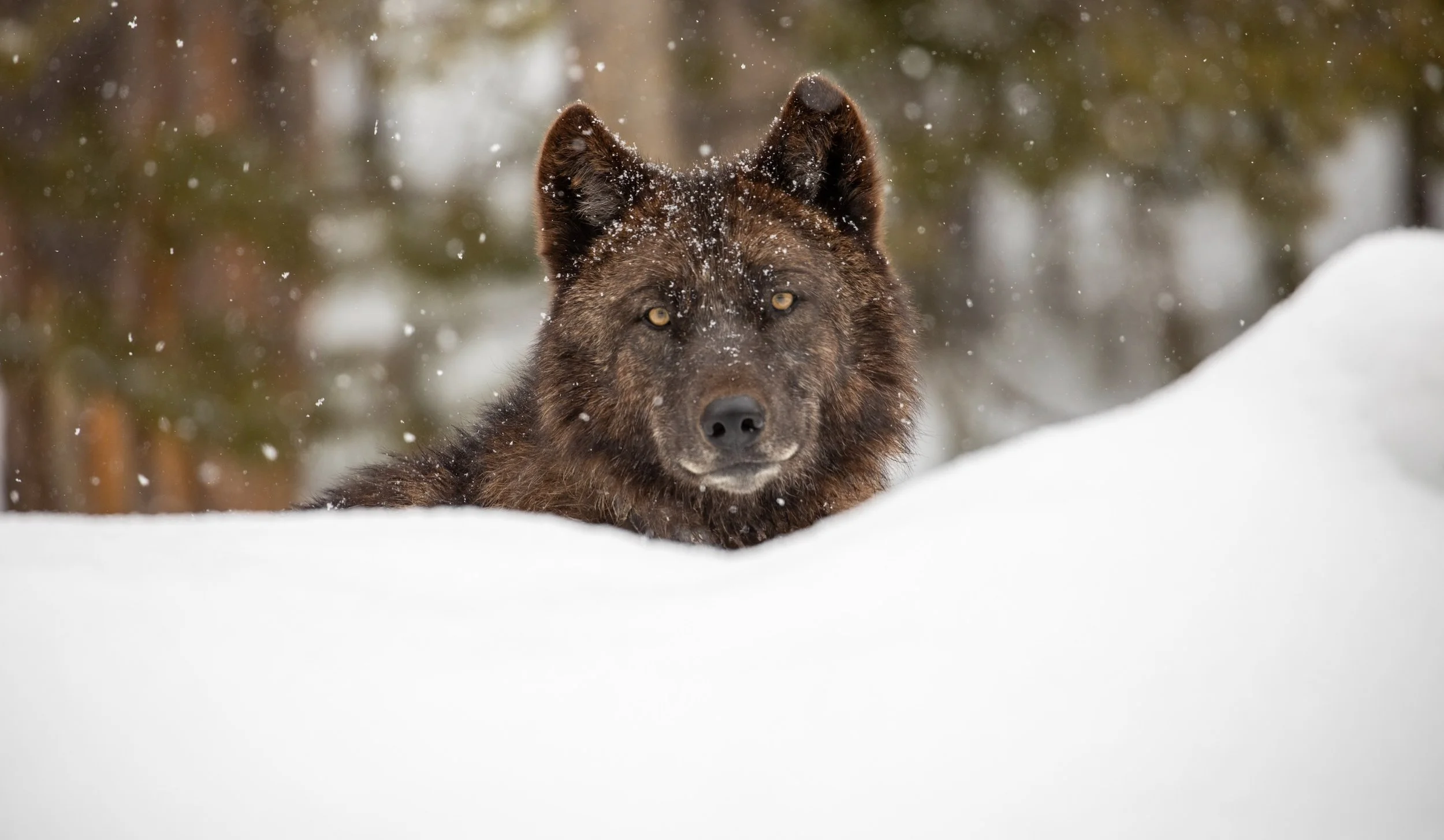
Yellowstone Wolves in Winter
Winter Wolf-Watching & Learning in Yellowstone
To Benefit the Wolf Conservation Center
February 21 - 27 and February 28 - March 06, 2027
7 Days - 6 Nights
$6726.95 PP Ex-Flights
$307.00 Single Supplement
Professional wildlife guide
Discover the winter world of Yellowstone’s wolves by day and evening lectures by world-renowned wolf experts,
followed by warm dinners and lively conversation with companions who share your passion for wolves.
Comfortable vehicle; all lodging and meals included.
Limited to 6 Guests each week
We are confirming the final details of the 2027 Winter Wolf Trips.
If you are interested in reserving your place or asking a question, we would love to hear from you. Please see below
2027 Winter Week 1
February 21 - 27, 2027
2027 Winter Week 2
February 28 - March 06
* Destination: Wildlife donates 10% of the proceeds from your tour to
The Wolf Conservation Center in YOUR name
Why This Tour is Special
This wolf in Yellowstone was unbothered by the snowfall or our presence watching from the roadside. Video thanks to Cara McGary of In Our Nature.
Passionate about Wolves? Discover the wolves’ winter world with a small group of wolf lovers from all corners of the world, sharing once-in-a-lifetime experiences by day and unforgettable stories over warm, cozy dinners.
The Wolf Conservation Center in South Salem, New York, directly benefits from your trip, each ticket includes a $500 donation to the WCC in your name - you receive the tax receipt.
Expand your knowledge and understanding of wolves. This tour offers more than just a chance to see wolves in the wild. Winter in Yellowstone is when passionate scientists, researchers, and documentarians from all over the world come to watch and study this unique population of wild wolves; you will be among them. Each evening our group will meet with an expert in the field to hear about their studies and research.
Your guide is a respected biologist who will share information and answer questions throughout our tour. She is passionate about wolves and all wildlife and dedicated to their conservation.
Chance encounters in the field with some of the world's premier wolf researchers, documentarians, and storytellers are possible. During past winter wolf trips, we have rubbed shoulders with members of the Yellowstone Wolf Project and university study teams, celebrated wildlife photographers and filmmakers, and enjoyed ad hoc stories on the mountain by the legendary Rick McIntyre. We never know who we will meet on the mountain!
Yellowstone in the winter is a magical place with few tourists, incredible scenery, and better chances to see the iconic wolves. It is something to remember for the rest of your life.
This is responsible tourism at work. Your travel dollars will stay in the local community. Local business owners provide the lodging and meals, and the economic benefits of the trip remain in the community, helping build the case that the Yellowstone wolves are worth more alive than as hunting trophies – in every season.
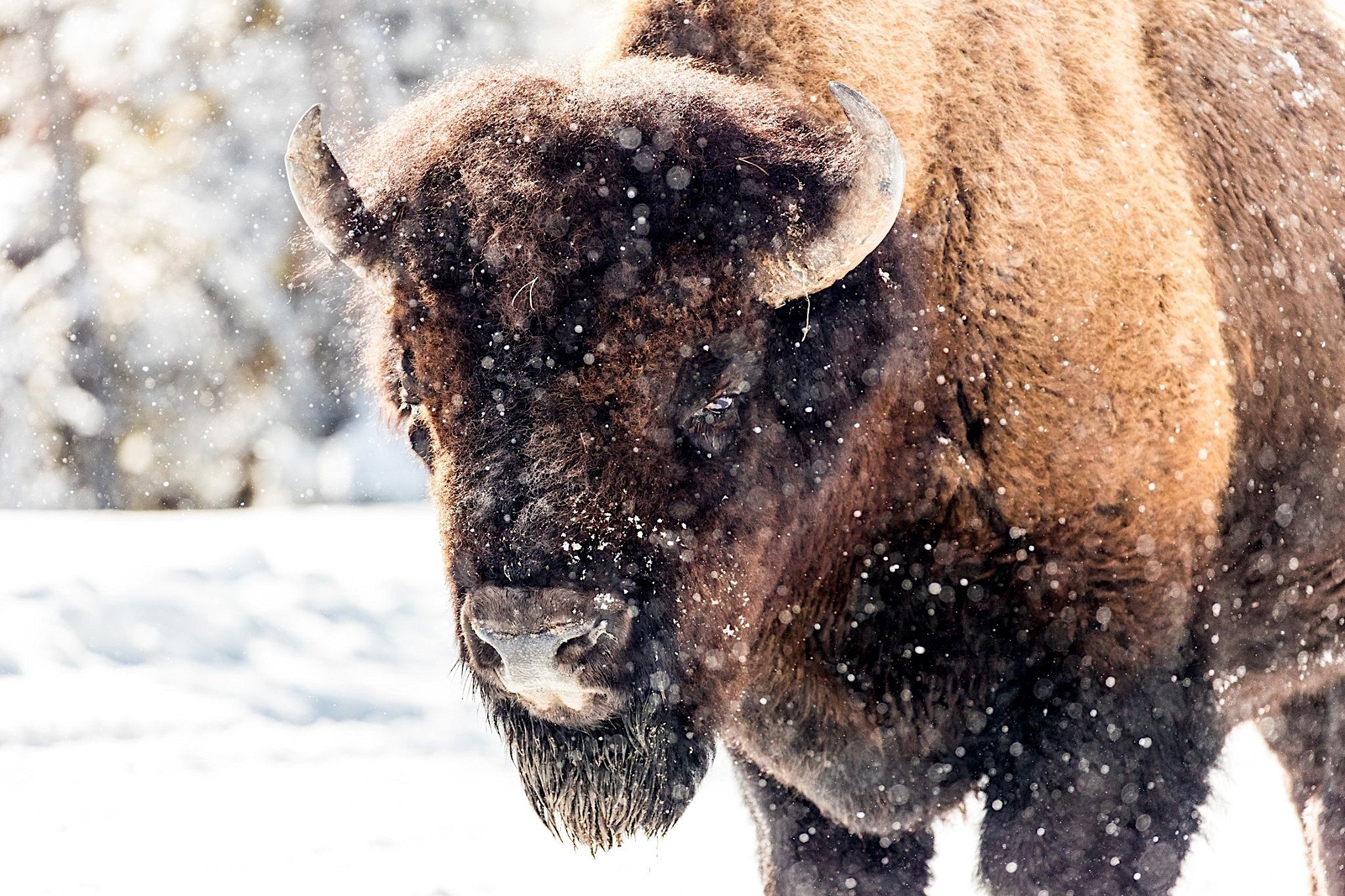
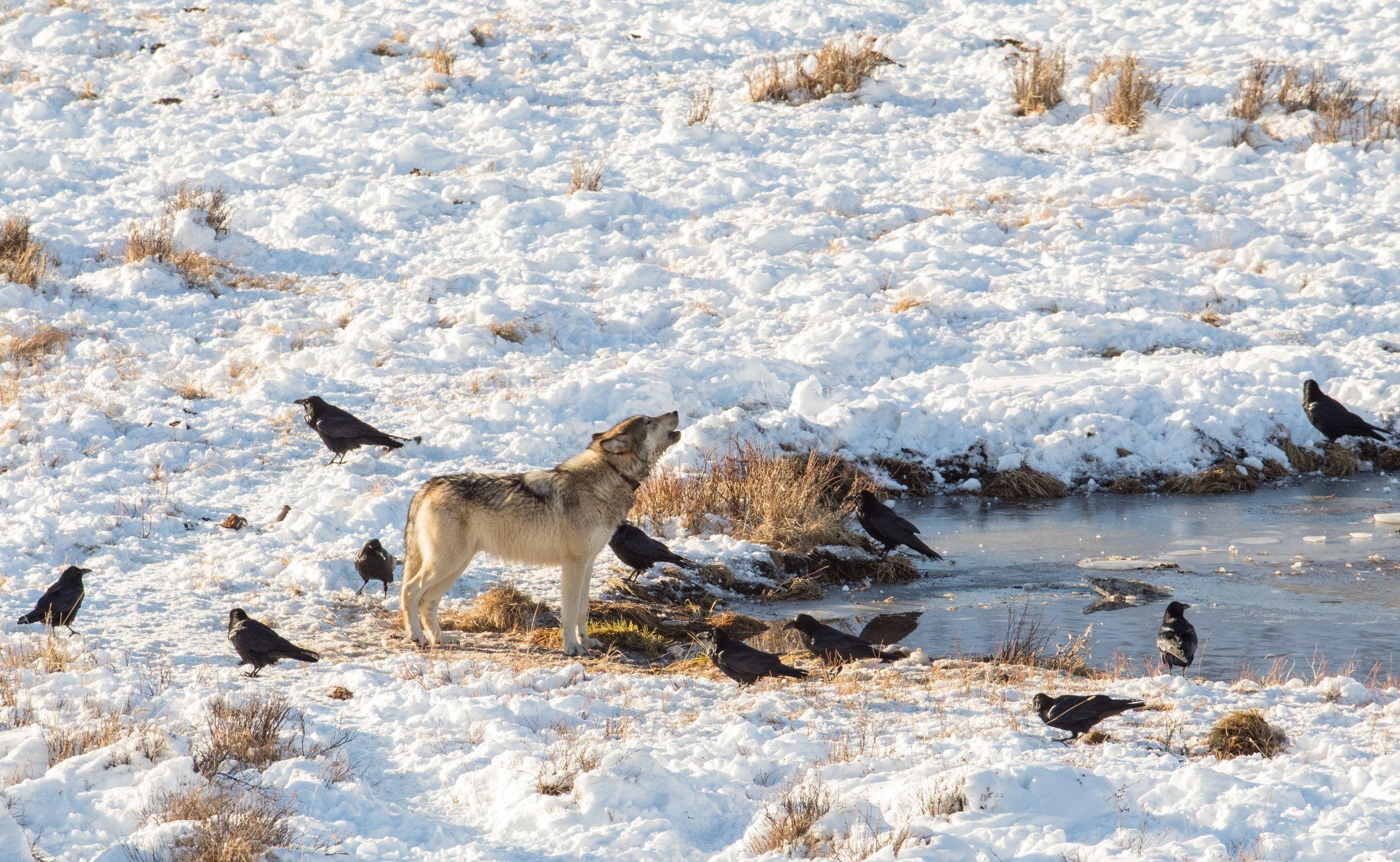
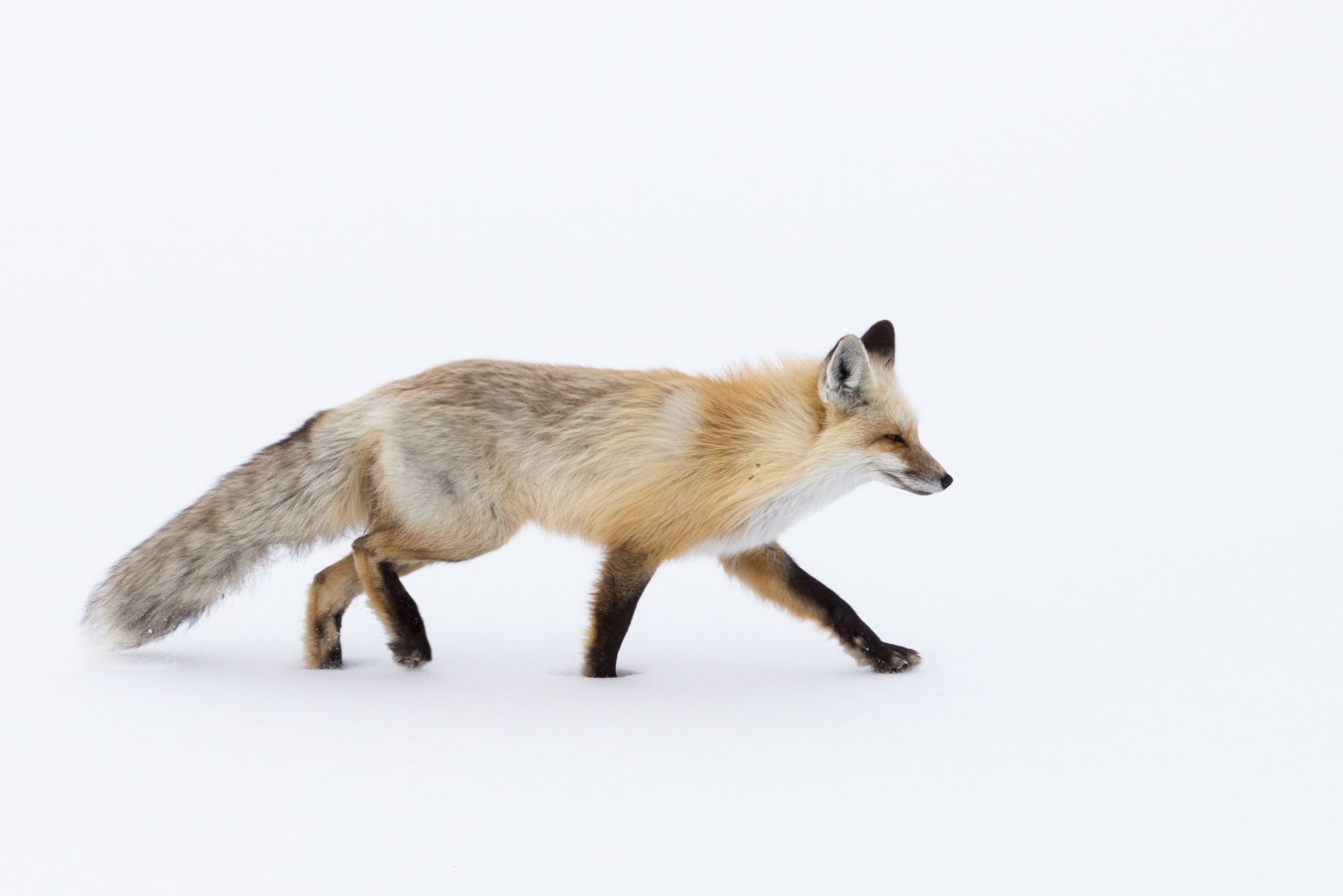
Detailed Itinerary
Detailed Itinerary
Day 1 Sunday, February 21 / February 28
Welcome to Montana!
Arrive in Bozeman and settle into the Lewis and Clark Hotel. Say hello to Lisa, the owner, and enjoy a freshly baked cookie and a hot drink at the complimentary coffee bar while you’re checking in. Our cozy hotel is within walking distance of the town. If your flight arrives early, rest, swim, or enjoy a sauna at the Lewis and Clark, or walk into town and explore the many shops and cafes! We will meet in the lobby at about 5:30 PM and head into Bozeman for a welcome dinner!
Included: Dinner
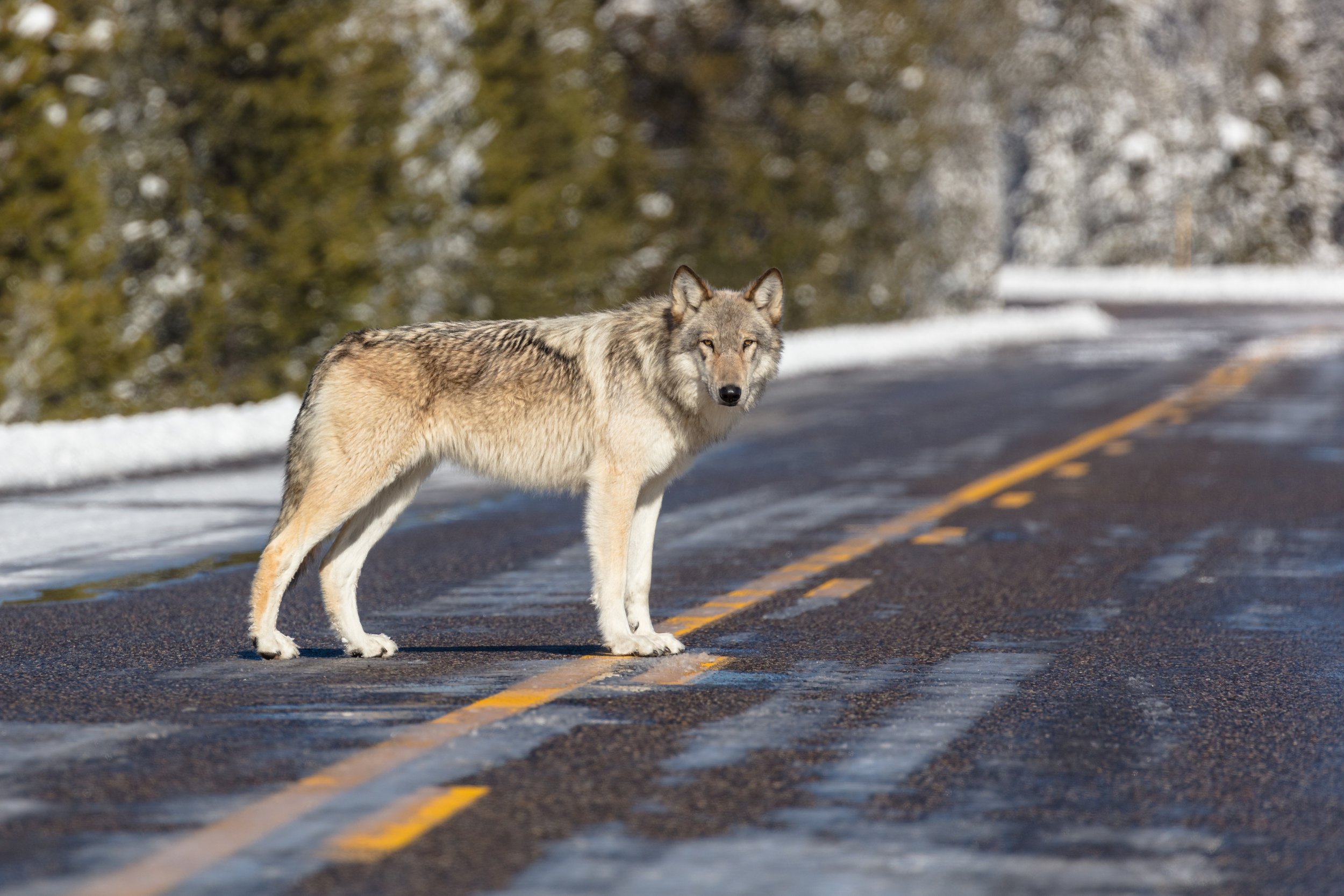
Wolf on the Northeast Entrance Road in Lamar Valley. Image courtesy of Yellowstone National Park.
Day 2: Monday, Feb. 22 / Mar. 01
Travel to Gardiner & Start Exploring Yellowstone
In the morning, after a lovely continental breakfast at the Lewis and Clark, we will be picked up and transferred to Gardiner, enjoying the magnificent scenery along the way. After arriving in Gardiner, we will check into our accommodations at the Wonderland Cafe and Lodge, located near the Park gate, and then break for lunch. This will serve as our base camp for the next three days.
Our guide, Cara, will meet us at the Lodge and introduce herself. We will then have our first look at Yellowstone National Park with a half-day exploration of the Mammoth Terraces, then head back to the lodge, freshen up, and enjoy dinner there.
Included: Light continental-style breakfast at the hotel, picnic lunch, and dinner.
Day 3: Tuesday, Feb. 23 / Mar. 02
The Northern Range Wolf Watching
After an early pick up (depending on sunrise, usually around 5:30) we are off to the Northern Range, the hub of wildlife in Yellowstone National Park. Our guide will fill us in on recent and historic events regarding Yellowstone wolves, their pack dynamics, litter size, and all things “wolf.”
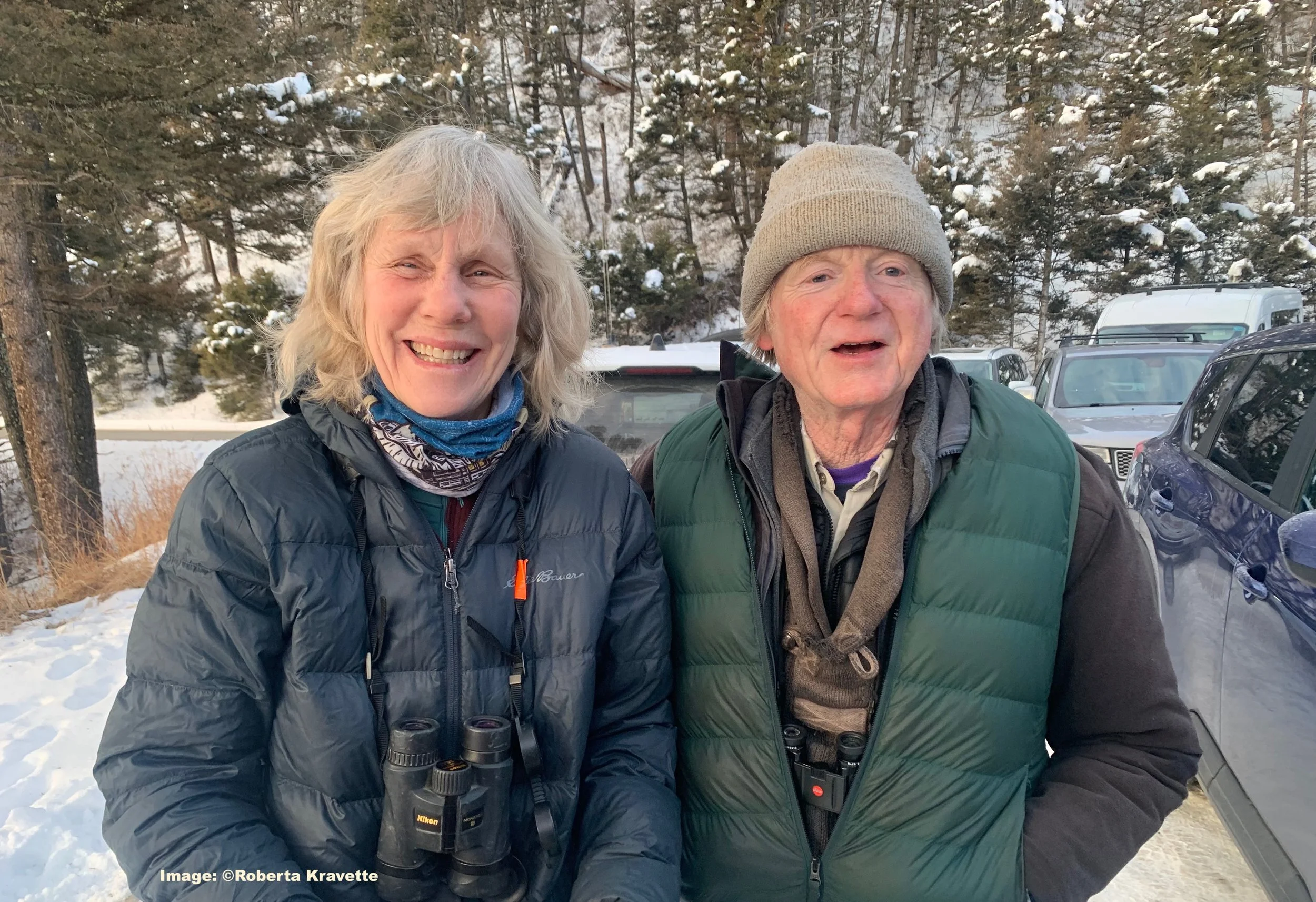
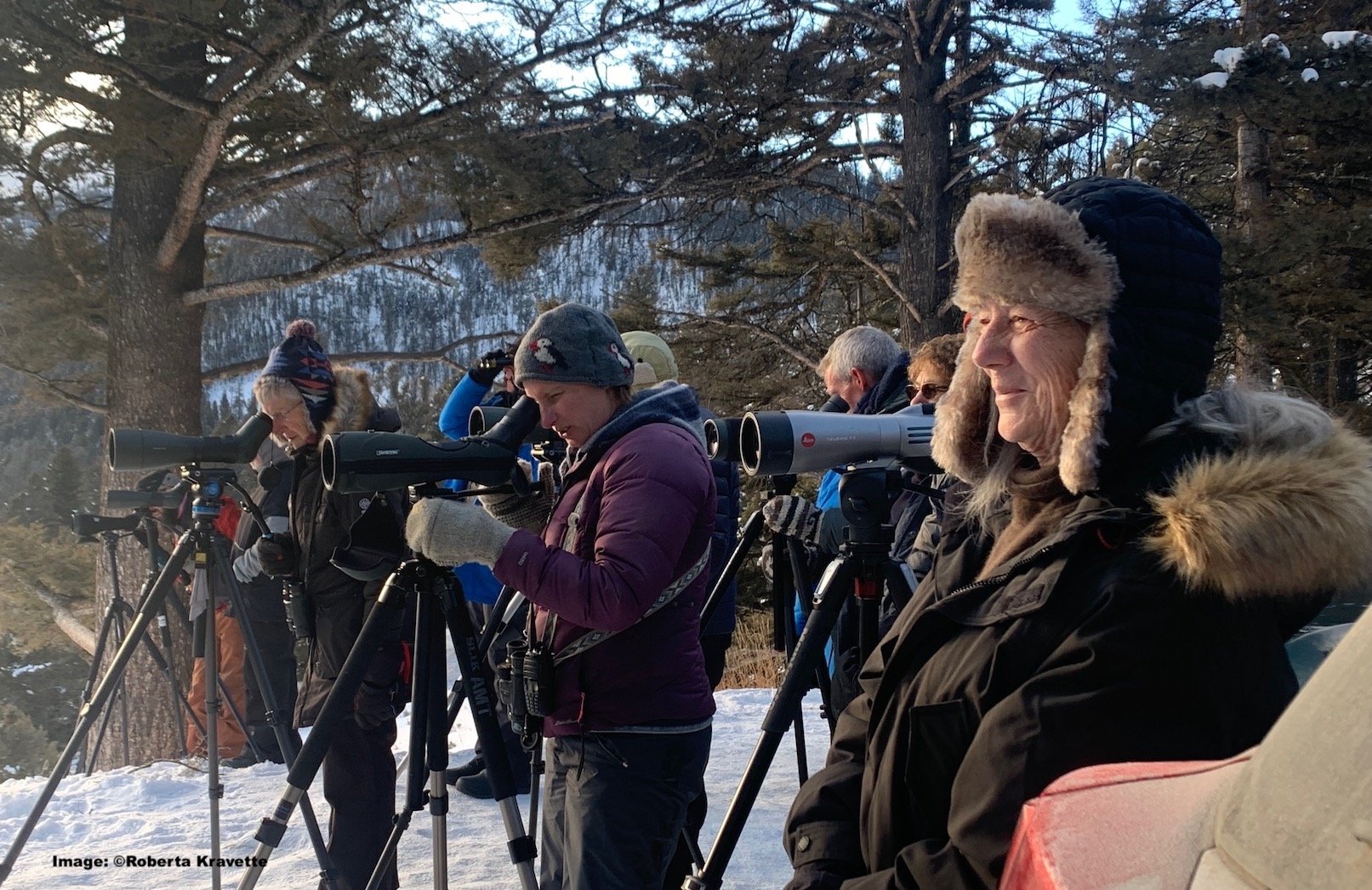
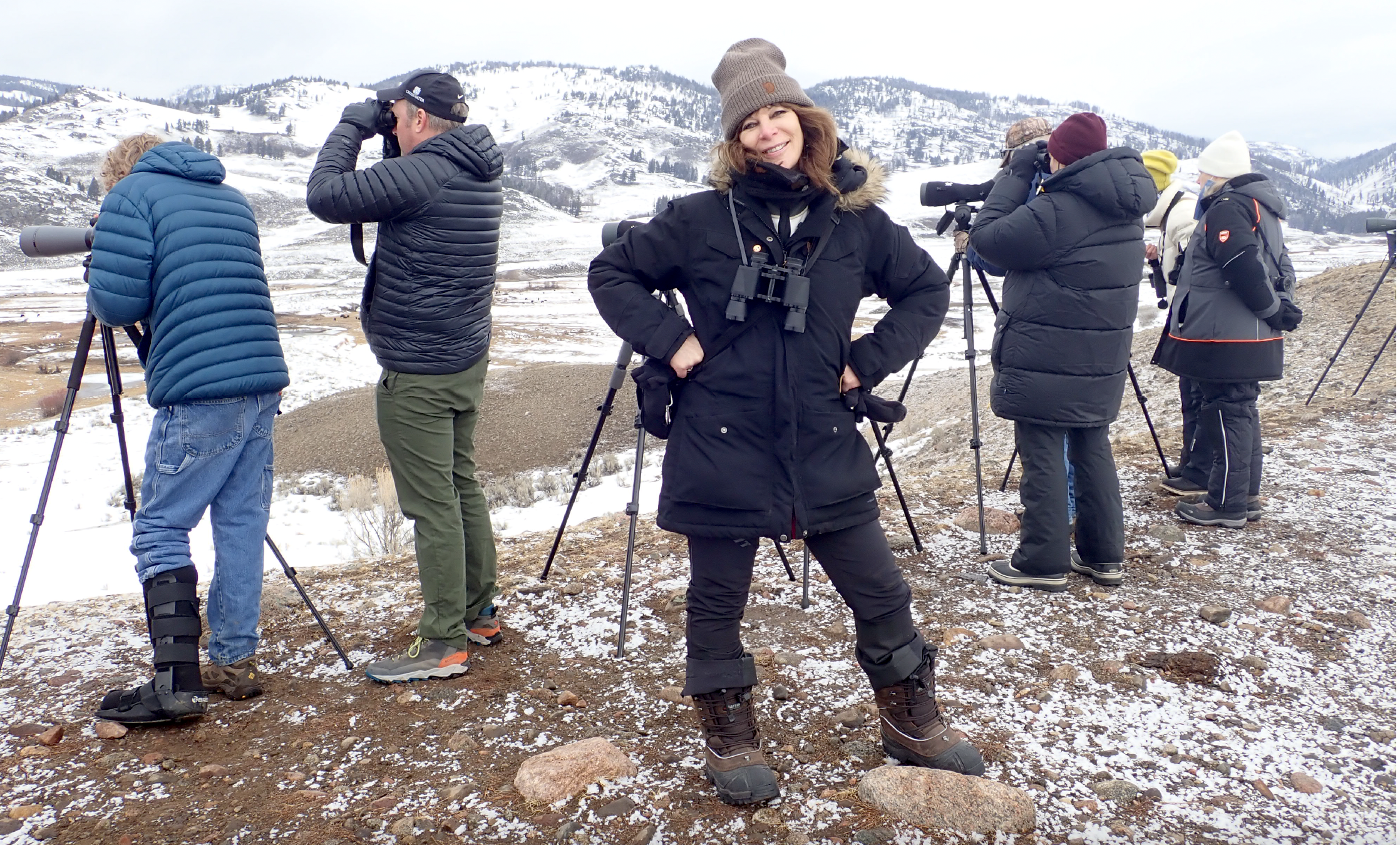
Early morning at Yellowstone with world-renowned wildlife biologist and author, Diane Boyd and beloved wolf expert and author, Rick McIntyre. We never know who we will meet. Image. ©Roberta Kravette
She will also put us in the best locations to view the animals, interpret behavior, and set up spotting scopes. We will always keep our distance from wolves and bears at 100 yards or more. The premium spotting scopes allow us to view the animals in detail, even at significant distances. Our guide, Cara, is an experienced biologist and naturalist with excellent wildlife interpretation skills.
After a morning in the Park, we will have a tasty lunch at a cafe or in the field.
Short walks may occur throughout the day. After about seven hours of exploring, we will return to our lodge.
In the evening, we will enjoy a private lecture by an expert in the field (to be announced later).
Dinner together at the lodge and a good night’s sleep will round out the day’s activities.
Included: Light breakfast in the field, lunch in the field, dinner at the lodge
Day 4: Wednesday, Feb. 24 / Mar. 03
Wolf Watching & Learning
Our guide, Cara, will pick us up at 5:30 or 6 am, depending on the sunrise. Early morning starts are essential for potential wildlife sightings. Today, we may drive further depending on recent and/or new sightings of our favorite animals.
Our wildlife tours are always dynamic and depend on wildlife movements and events. For example, we may be lucky enough to stumble upon a fresh carcass. Or we may see mating behavior, or wolves, coyotes, foxes, eagles, ravens, and others that may come from afar to participate and fight for a meal.
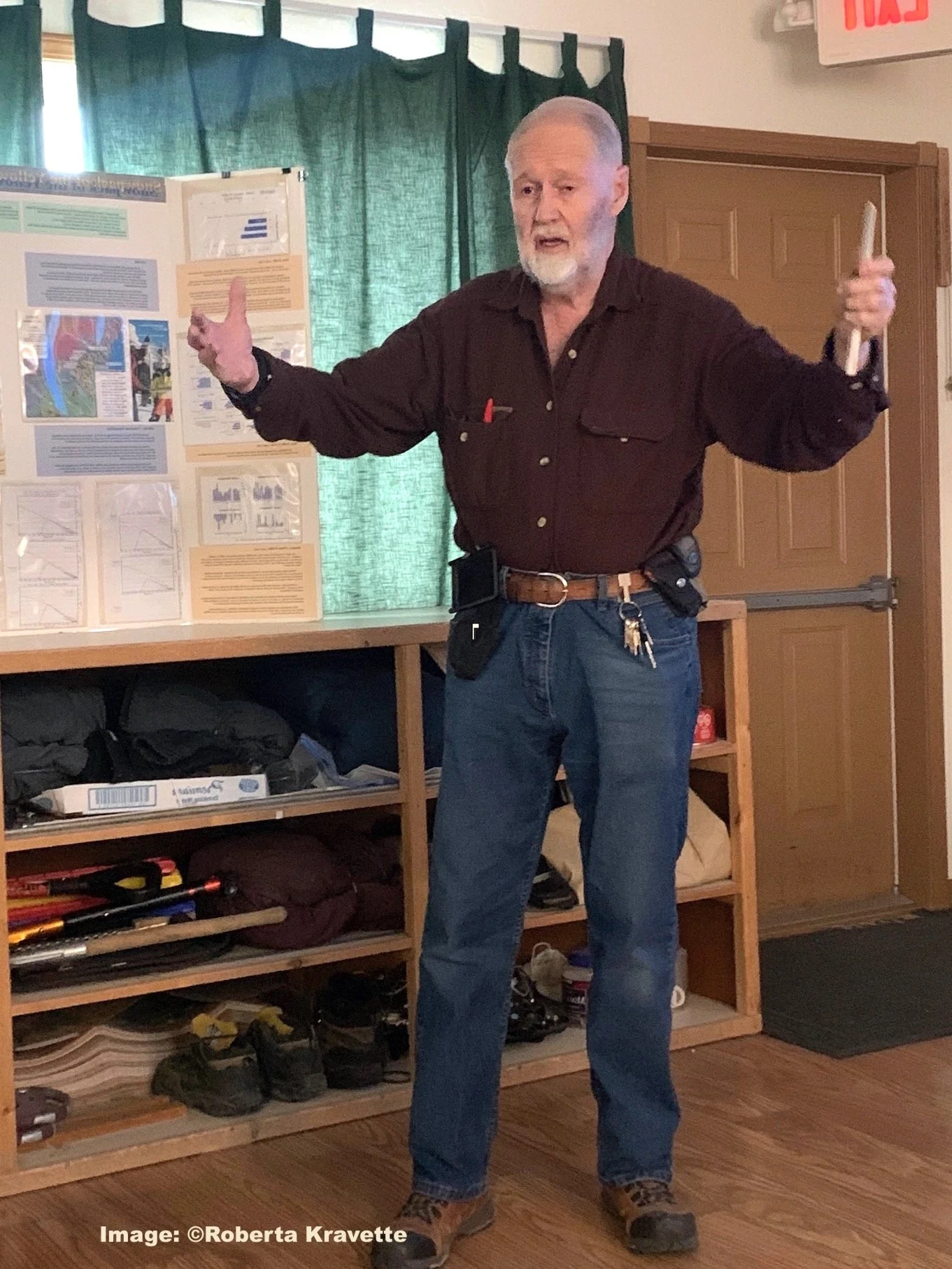
Forensics expert Jim Halfpenny speaking to our group.
Image: ©Roberta Kravette
Short walks may occur throughout the day. After about seven hours of exploring, we will return to our lodge. In the evening, we will enjoy a private lecture by an expert in the field (to be announced later). Dinner together at the lodge and a good night’s sleep will round out the day’s activities.
Included: Light breakfast in the field, lunch in the field, dinner at the lodge
Day 5: Thursday, Feb. 25 / Mar. 04
A Flexible Day
Depending on how successful we were on previous days and the group's interests, we will have the option of either another exploratory safari or a short hike to one of the various areas. Lunch in the field.
Short walks may occur throughout the day. After about seven hours of exploring, we will return to our lodge. In the afternoon, we will enjoy our final meeting with an expert in the field (to be announced later). Dinner together at the lodge and a good night’s sleep will round out the day’s activities.
Included: Light breakfast in the field, lunch in the field, dinner at the lodge
Day 6: Friday, Feb. 26 / Mar. 05
An Early Drive & Return to Bozeman
Today, we will offer a half-day with an early start. Depending on the interests and abilities of the group, this may be a birding trip, a search for an animal we have not yet seen, or something else.
After lunch in Gardiner, we will travel back to Bozeman to our cozy hotel and say good-by to our wonderful guide. This evening, we will celebrate our adventure with a farewell dinner at a nearby restaurant and a good night’s sleep.
Included: Breakfast at the lodge or in the field, TBD, lunch in Gardiner, farewell celebration dinner in Bozeman.
Day 7: Saturday Feb. 27 / Mar. 06
Homeward Bound
We will enjoy our final Continental breakfast at the hotel. Your transfers to the airport are usually scheduled for pickup 2 hours prior to your flight. Rob, owner of the local transfer company, will advise us - he has never let us down.
Wildlife
Wildlife
The wildlife hub of the Continental United States is Yellowstone National Park, and the northern area of the Park, specifically the Lamar Valley, has its greatest concentration of wildlife. This is where we will spend the majority of our time. And winter is a great time for observing wildlife in the park.
Many animals migrate from higher elevations to lower areas with less snowpack and wind, allowing observers to see more wildlife closer to park roads and facilities. And the white landscape makes spotting wildlife easier because their dark silhouettes stand out against the snow. Perhaps best of all, there are far fewer crowds to contend with than in the summer months, providing a quieter, more natural experience.
Mammals
The Pine Martin. Is this the cutest carnivore in North America? Photo courtesy the National Park Service.
Yellowstone National Park and the Greater Yellowstone Ecosystem have the greatest concentration of mammals in the Lower 48. In addition to the absolute numbers, Yellowstone is known for its biodiversity, with 67 known mammal species calling the park home.
Amongst the mammals in the park are many different types of rodents, including several squirrel species, chipmunks, marmots, and beavers. Hares, rabbits, and pikas also live throughout the park. There are seven naturally occurring large ungulates in the park. Bison are the most iconic, but bighorn sheep, moose, pronghorn, elk, mule deer, and white-tailed deer also call the park “home.” Mountain goats are not native to Yellowstone but have colonized parts of the park.
There are also numerous carnivores, including three cats (cougars, bobcats, and Canadian lynx), three canids (gray wolves, coyotes, and red foxes), and two types of bears (brown or grizzly bears & black bears). In addition, wolverines, badgers, river otters, long and short-tailed weasels, and martens also call Yellowstone “home.” Please note: We will (most likely) not see bears as they hibernate at this time.)
Wolf pack at play. Image: ©Doug Smith. Courtesy National Park Service.
A special note on wolves: From 1995 to 1997, 41 wild wolves from Canada and northwest Montana were released in Yellowstone. All of the wolves currently in the Greater Yellowstone Ecosystem descend from these 41 original wolves. As of January 2023, there are at least 108 wolves in the park. Ten packs were noted. Wolves in Yellowstone sit at the core of a larger population connected throughout the Greater Yellowstone Ecosystem. The wolf population has fluctuated between 83 and 123 wolves since 2009.
Yellowstone is home to the world’s longest-running wild wolf study. Much of the research happens during the winter when the park is mostly closed, and there are few visitors. Exactly when we will be visiting!
Want to know more about Yellowstone’s wolves? See Q&A videos with Doug Smith hosted on the Yellowstone National Park page. Doug Smith is the project leader for the Wolf Restoration Project in Yellowstone and has been with the program since its inception. Doug has studied wolves for over 20 years. Prior to Yellowstone, he worked with wolves in Michigan (Isle Royale National Park) and Minnesota.
Birds
Bald Eagle enjoying breakfast. Image: ©Jim Peaco. Courtesy National Park Service.
Records of bird sightings have been kept in Yellowstone since the park was established in 1872. Nearly 300 species of birds have been documented, including raptors, songbirds, shorebirds, and waterfowl. According to the National Park Service, approximately 150 species nest in the park. A wide variety of habitat types and a range fo elevations found within Yellowstone contribute to the relatively high diversity of bird species.
In the winter, raptors are the birds most easily seen. Sightings of bald eagles and golden eagles are common. Northern harriers, red-tailed hawks, rough-legged hawks, northern goshawks, Cooper’s hawks, and sharp-shinned hawks are also winter inhabitants, but less commonly sighted. You may catch sight of an American kestrel or a prairie falcon, too. Great horned owls, northern pygmy owls, great grey owls, boreal owls, and northern saw-whet owls make Yellowstone home in the winter.
Magpies and ravens will be common around wolf kills. Look for trumpeter swans along waterways, and keep an eye out for the American dipper, North America’s only truly aquatic songbird, also known as the water ouzel.
This robin-sized bird repeatedly walks along the bottoms of the frigid and fast-flowing streams looking for choice water insects hidden beneath the stream's pebbles. Likely sightings also include Barrow’s goldeneye, lesser scaup, Clark’s nutcracker, mountain chickadee, the red-breasted nuthatch, and the rosy finch. Woodpeckers, especially hairy woodpeckers, can also be seen. Last but not least, keep an eye out for gray jays, not only for the sighting, but they are not known as "camp robber barons" for nothing!
You can find a complete Yellowstone birding checklist on the NPS website.
Others
Yellowstone cutthroat trout—native to Yellowstone—are a keystone species that many species of birds and mammals rely on as an energy source. Image: ©Jay Fleming. Courtesy National Park Service.
Fish: Yellowstone has 11 species of native fish and 5 introduced species. Although we are unlikely to see many in the winter, Yellowstone and westslope cutthroat trout are the most icon of these species/
Amphibeans: There are five species of amphibians in the park: these are Western tiger salamander, boreal chorus frog, Western toad, Columbia spotted frog, and plains spadefoot toad. To survive the winter, some Yellowstone amphibians go into water that does not freeze (spotted frogs), others enter underground burrows (salamanders and toads), and others (boreal chorus frog) tolerate freezing and go into a heartstopped dormancy for the winter in leaf litter or under woody debris.
Reptiles: Reptiles are less studied than amphibians in Yellowstone. There are 6 confirmed species: bullsnake, prairie rattlesnake, rubber boa, sagebrush lizard, common garter snake, and terrestrial garter snake. We are very unlikely to see reptiles during the winter.
Accommodations
Accommodations
At Destination: Wildlife, we strive to apply the principles of conservation tourism - travel that supports wildlife, habitats, and local communities. This implies a commitment to ensure your tourism dollars stay local, creating jobs and improving the livelihoods of those that live there. We use locally owned and operated accommodations, restaurants, and other providers for these reasons. But this commitment also ensures you receive the personal touch only a small business can provide while giving you a more authentic experience.
Bozeman
We will stay at the Lewis & Clark Hotel on our first and last nights—a charming second-generation, locally-owned establishment with deep roots in the community and easy access to the airport.
The rooms are comfortable, the atmosphere welcoming - and owner Lisa’s cookies are delicious. Located on the edge of historic downtown Bozeman, it is within walking distance to shops, restaurants, and galleries.
Bring a bathing suit and enjoy their sauna, steam rooms, or pool! Tea and coffee are available 24/7, as are Lisa’s yummy cookies. Continental breakfast included.

The Lewis and Clark’s cozy rooms are lovely - but you might fall in love with the lobby. Staying here is like coming home to your favorite Auntie.
Gardiner
While in Yellowstone, we will stay at the Wonderland Cafe and Lodge in the heart of Gardiner at the North Entrance to Yellowstone NP.
Rooms are studios or large shared suites. Each Guest, unless traveling as a couple, will have their own bedroom and bath - some guests will share a kitchen (sink, stove, microwave, refrigerator) and sitting area.
NOTE: The lodge area, your room, can only be accessed by an outside stairway. There is NO elevator.
The Wonderland Café and Lodge is owned and run by a local mom.

The cozy living area with kitchen behind in the Lion’s Den at the Wonderland Lodge
Tour Information
Tour Information
Yellowstone gray wolf making its way through the snow. Image: ©Frank W. Jacob. Courtesy National Park Service.
Dates
Week 1 Tour: February 21-27,2027
Week 2 Tour: February 28- March 06, 2027
Price
$6724.00 pp ex flights. *Single-room supplement of $307.00 in Bozeman that covers the arrival night and the night before departure.
*Please note: Single rooms are applicable in Bozeman only; our stay at the Wonderland Lodge will be in large suites.
In Gardiner, solo travelers will each have a private bedroom and private bath in a suite, sharing a kitchen and living room with one other guest.
Couples may have a private suite or a shared suite with a private bedroom and bath.
A 10% donation in your name to the Wolf Conservation Center is included in the tour price and is tax-deductible for US residents. You will receive a receipt from the Wolf Conservation Center.
Group Size
Limited to 6 Guests. The group size on this tour is limited to 6 guests plus a tour leader and a guide. An important aspect of responsible tourism is maintaining a limited group size, and wildlife is always best experienced in smaller groups.
Our small group size is less likely to affect wildlife behavior, and will allow each of us to enjoy more meaningful interactions with our wildlife guide and guest speakers, and provide us with greater flexibility in our daily itinerary decisions.
Included
►Accommodations,
►Services of a Destination: Wildlife trip leader and
►Professional guide, local wildlife guide, vehicle
►Private evening presentations on wolf biology and behavior or other subjects pertaining to Yellowstone, wolves, or wildlife,
►All meals (Light breakfast, Lunch, and Dinner) from dinner on Day 1 through breakfast on the final day,
►Snacks during the excursions,
►Airport transfers on the first and final days, and transfers between Bozeman and Gardiner.
► Donation: A 10% donation to the Wolf Conservation Center in your name is included in the price of the tour and is tax-deductible for US residents.
► Tips for your Guides and meals
Not Included
►Travel to and from Bozeman, Montana,
►Alcoholic beverages
► * Park entry fees,
* Please note that the National Park Service does not allow registered park guides to purchase passes to Yellowstone National Park for their
clients. Passes must be purchased before entering the park. Please see below.
►Items of a personal nature (phone calls, laundry, internet, souvenirs, etc.),
►Airline baggage fees, airport and departure taxes (if any),
►Travel insurance protection and medical evacuation insurance.
If you already have a National Park Pass, please bring it. That is all you need, but you must remember to bring it.
Under 62-yo? If you DO NOT have a National Park pass, the most economical option at this time is an annual pass, which costs about $80 in 2026.
Over 62-yo? Those over 62 can purchase a lifetime pass for the same price. If you have one, please bring it.
Breakfast is served! Coyotes dine on a wolf kill while ravens wait their turn. Image: ©Roberta Kravette
Physical Requirements
Easy. With a Caveat: We will be at an elevation.
This wolf-watching tour with Destination: Wildlife requires very little walking. Travelers, however, must be able to walk up/down four flights of stairs because there are no elevators at the Wonderland Lodge in Gardiner.
Excursions are generally on smooth roads but involve several hours of intermittent driving each day. There will be short walks on icy road-sides or paths. There may be a longer walk with elevation gain, depending on the wildlife. Guests should have a good balance and be able to walk unaided.
Many guests bring a walking pole “just in case.”
Guests must be prepared for below-freezing temperatures and slippery surfaces. YAK-TRAX (without spikes) are mandatory. Please see the packing list.
Meals
Please Note: Dining options in Gardiner are severely limited. Most dinner restaurants in Gardiner are closed at this time of year. We will NOT use the vehicle after dark due to unpredictable weather, wildlife habits, and other considerations. All of our dinners in Gardiner will be taken at the Wonderland Cafe. The selections are limited but freshly prepared.
Wyoming and Montana are beef country. Most dietary restrictions (plant-based diets, gluten-free, etc.) can be accommodated at Gardener’s Wonderland Cafe because our host practices farm-to-table and hand-crafted cuisine. The selections may be limited, but the quality is good. However, our dining options are also relatively limited in Bozeman; please let us know as soon as possible of any dietary requirements due to serious medical conditions or strict personal restrictions.
Smoking and Fragrances
Smoking of any substance is stricly prohibited on this tour. Vaping is allowed outside, downwind of the van, if necessary. There is no smoking in the hotels, lodges, cafes, or other venues.
Please limit fragrances of any kind, including perfume, lotions, sanitizer etc.
This is to protect our Guests, some of whom may have lung sensitivities exacerbated by thin air and elevation, and also make for better wildlife viewing. Wildlife tends to flee from human scents.
Need to Know
Yellowstone is cold in February and March. Temperatures range from zero to 20°F (-18°C to -7°C) throughout the day. Sub-zero temperatures are common, especially during the early morning when we begin our wolf-watching excursion and at higher elevations. The record low temperature is -66°F (-54°C). Wind chills well below zero should be expected, and you will be stationary most of the time outside the vehicle. Appropriate clothing is paramount.
Please look at the suggested packing list and contact us with any questions.
Regarding Wolves: Wolves are in Yellowstone year-round, but the mid-winter months are known for the quantity and quality of wolf sightings, especially in the Lamar Valley. During the winter, less foliage and the white snow make it easier to see the wolves, and the cold weather drives their prey into the valleys, where they, too, are more easily sighted. In addition, the wolf packs living in the Lamar Valley have become accustomed to humans along the roads and are less likely to hide. This combination makes sightings of wolves in this area common during the winter. BUT conditions vary, and wolves here live wild and free: we do not guarantee that you will see wolves or any other wildlife, nor can we promise exactly what your experience will be.
Early Mornings: The best time for wolf sightings is usually around first light and slightly after. That means we must depart as early as 5 AM, depending on the time of dawn and sunrise. If you miss the daily start time, you will be left at the lodge for the day; we will not hold the rest of the group.
Getting There and Back
Flights: Please schedule your flights to arrive by 3 pm to allow time for delays and to attend the orientation/welcome dinner on Day 1 of the tour. You are free to depart at any time on the final day. If you would like to arrive a day early (Day 0) please let us know in advance, we will arrange your accommodations.
Airport Transfers: Please let us know the carrier, flight number, and arrival and departure times. Your airport transfers are included IF we have your information.
Cancellation Policy
Due to the nature of our tours, no refunds are available once a tour has started or for any package, accommodations, meals, or other included services. We understand that sometimes, even the most eagerly anticipated plans may need to be canceled. Please see below for our cancellation policy.
We strongly recommend that every traveler purchase travel insurance.
Cancellation: More than 120 Days
Forfeiture of 20% of trip fees, including extensions, plus any specified donations to the sponsor, any non-refundable train/airfare, and a $150 cancellation processing fee.*
Cancellation 120 to 90 Days
Forfeiture of 30% of trip fees, including extensions, plus any specified donations to the sponsor, any non-refundable train/airfare or other, and a $150 cancellation processing fee.*
Cancellation 90 to 61 Days
Forfeiture of 50% of trip fees, including extensions, plus any specified donations to the sponsor, any non-refundable train/airfare or other, and a $150 cancellation processing fee.*
Cancellation 60 Days or Less
Forfeiture of 100% of trip fees, including extensions, plus any specified donations to the sponsor, any non-refundable train/airfare or other, and a $150 cancellation processing fee.*
*Where another guest fills the space, a portion of your fees may be eligible for an additional partial refund, subject to Destination: Wildlife's sole and exclusive discretion.
Travel, Medical, and Evacuation Insurance
Travel Insurance: We strongly recommend travel insurance to protect you against travel delays, cancellations, lost luggage, medical emergencies, and other unexpected events. There are many good travel insurance providers. We have worked with Allianz for many years and recommend them as cost-effective, comprehensive, and fair. They offer multiple policy options and will cover couples or families traveling together under a single plan. We are happy to provide a comparison of their policies for you. Just ask.
Evacuation Insurance: This is NOT travel insurance. Evacuation insurance will evacuate you in case of a medical or other emergency. It is a membership plan that covers you for a year or more, regardless of the location of the emergency, from your backyard to the Himalayas.

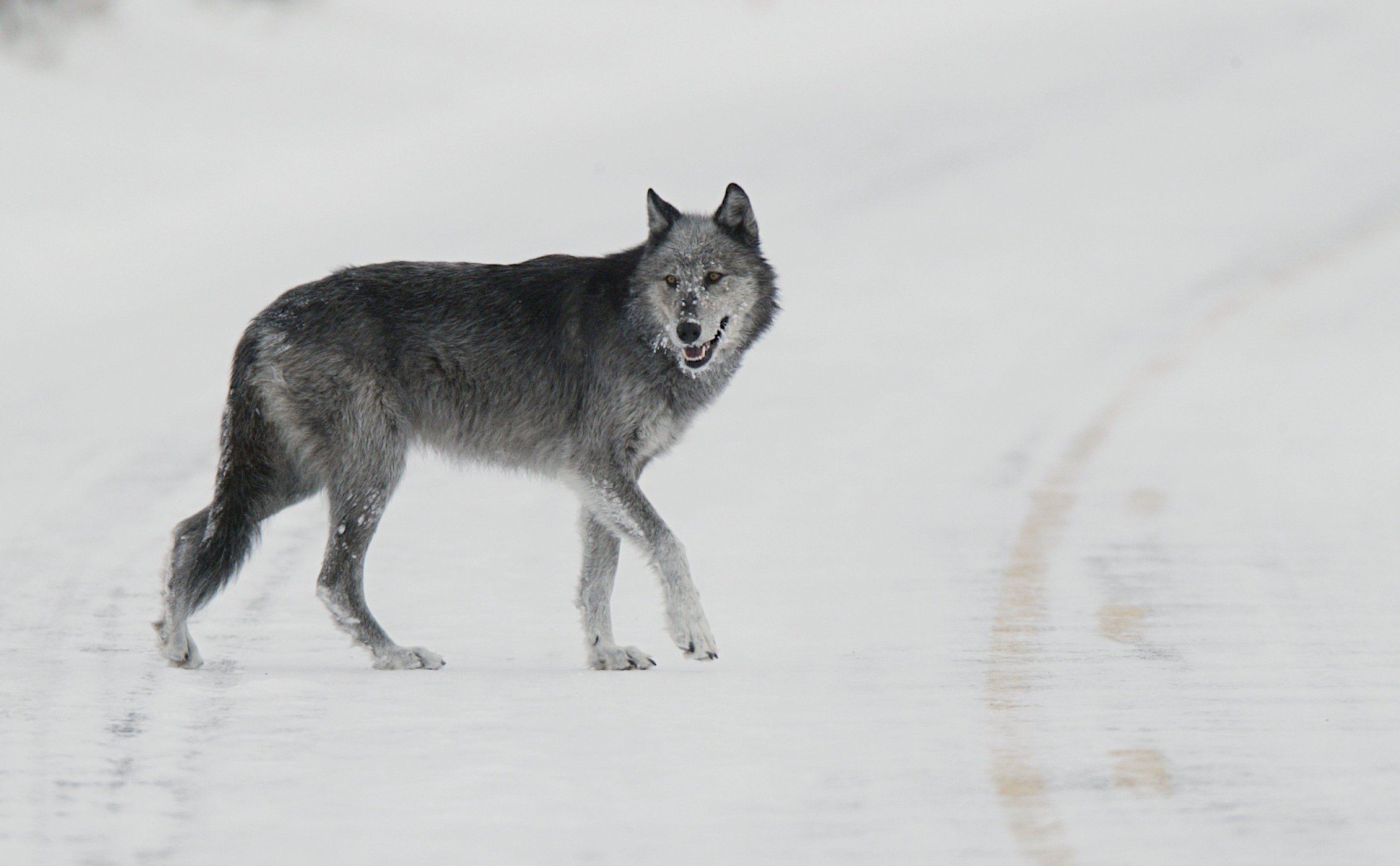
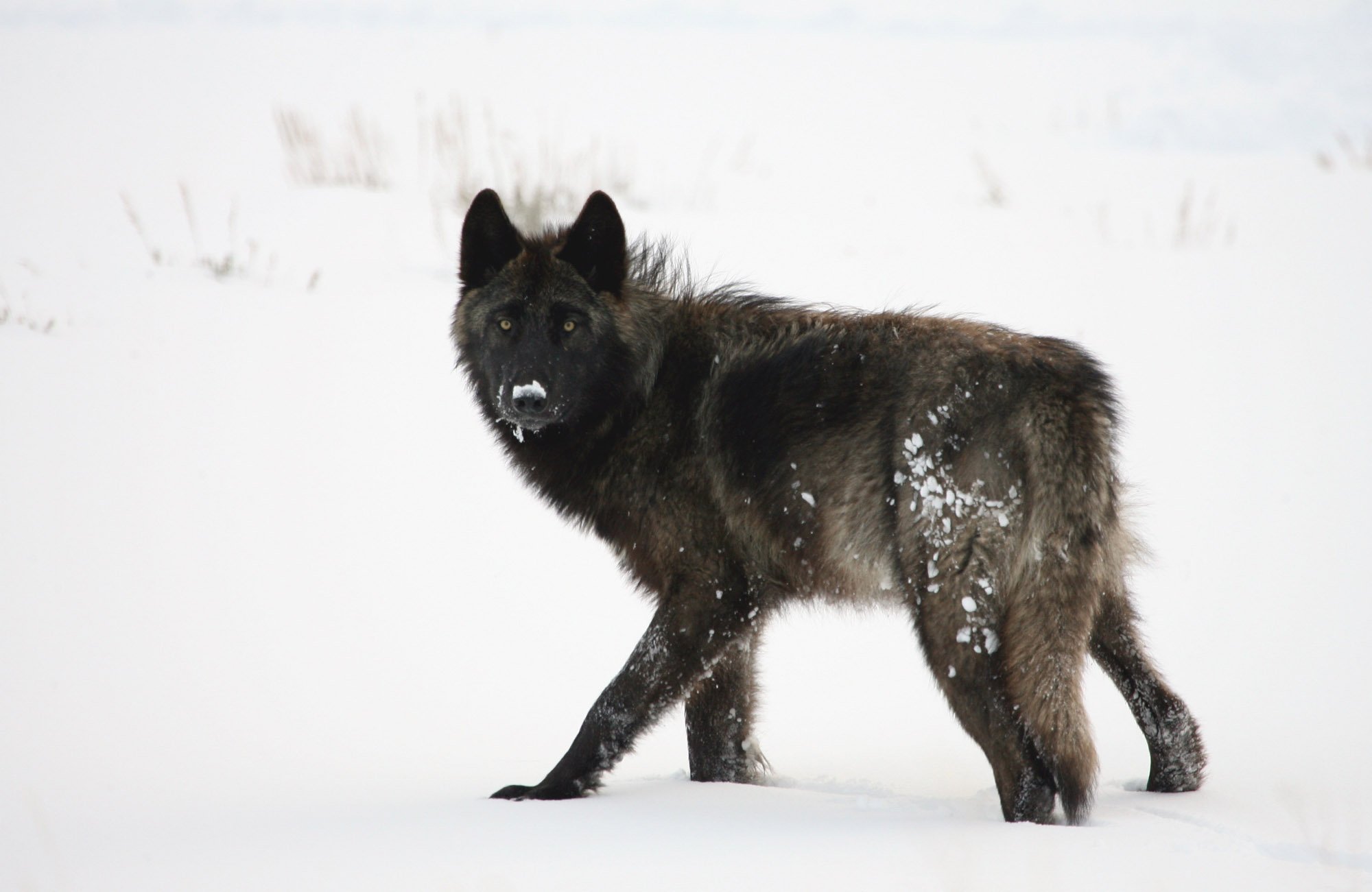
Black wolf in the Lamar Valley. Image: ©Jim Peaco. Courtesy National Park Service.
Making a Difference
How Your Trip Makes A Difference
Wolf Conservation Center
Our mission is to advance the survival of wolves by inspiring a global community through education, advocacy, research, and recovery
The Wolf Conservation Center in South Salem, New York is committed to teaching people about wolves, their relationship to the environment, and the human role in protecting their future.
Founded by Hélène Grimaud in 1999, the Wolf Conservation Center (WCC) is a 501(c)(3) not-for-profit environmental education organization working to protect and preserve wolves in North America through science-based education, advocacy, and participation in the federal recovery and release programs for two critically endangered wolf species - the Mexican gray wolf and red wolf.
The WCC's three 'ambassador wolves' reside on exhibit where they help teach the public about wolves and their vital role in the environment. Through wolves, the WCC teaches the broader message of conservation, ecological balance, and personal responsibility for improved human stewardship of our World.
Go to nywolf.org to learn more about this wonderful organization.
Greater Yellowstone & Wolves
Two wolf brothers share a yawn. Image courtesy Wolf Conservation Center
Your tourism dollars help ensure the future of Yellowstone’s wolves, flowing to local communities living in and around the greater Yellowstone ecosystem, creating jobs, and improving livelihoods. Your presence becomes a powerful incentive for these communities to protect their natural resources, including the wolf. A recent study concluded that wolf-watching in Yellowstone National Park generates upwards of $35 million in tourism revenue annually for businesses in Montana, Wyoming, and Idaho. By practicing responsible conservation tourism, we ensure that our dollars stay local and help support families and individuals even after we leave.
When it pays it stays. We practice wolf conservation by making wolves worth more alive than as a trophy or political statement, and this tour makes you part of that effort.
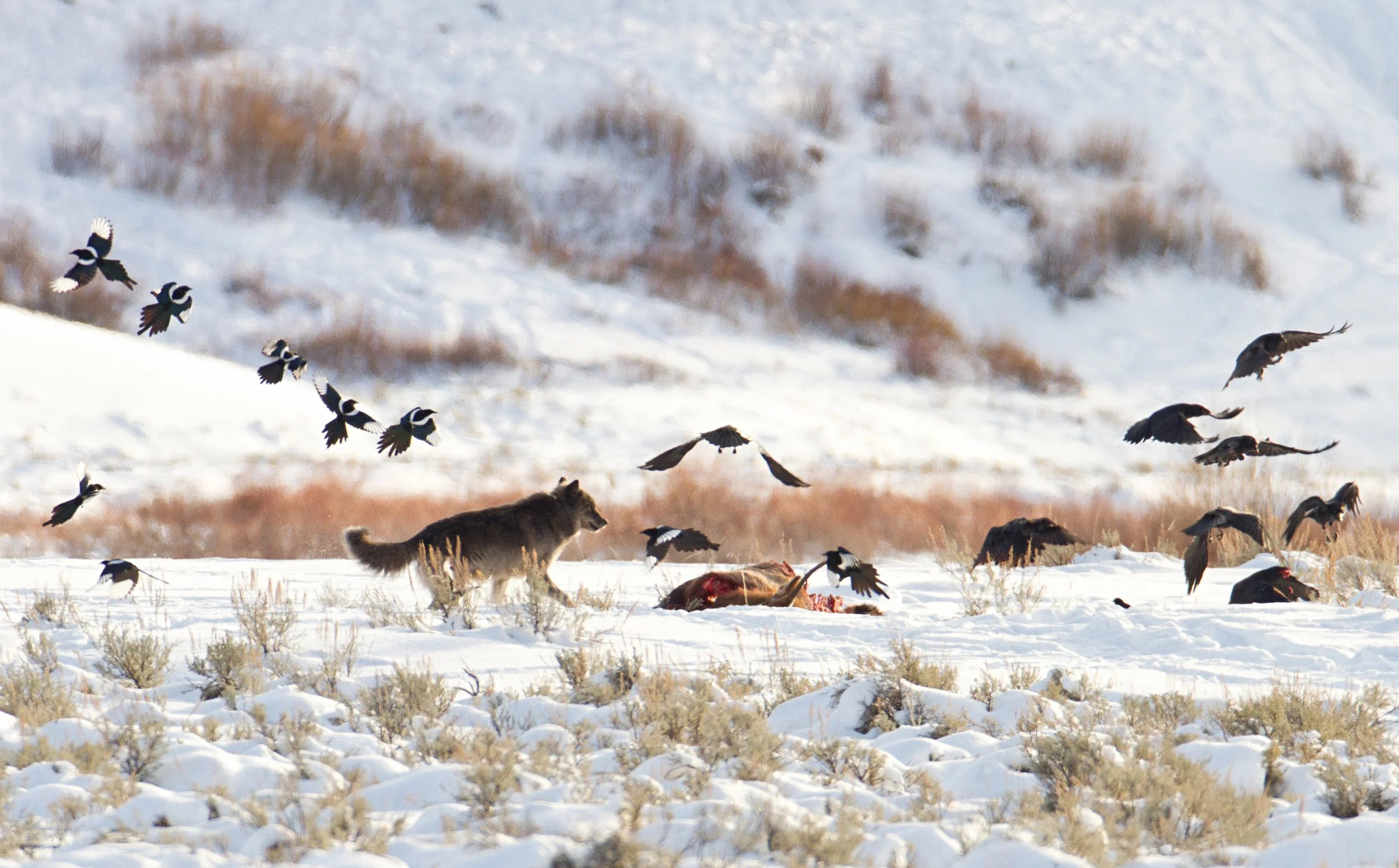
Magpies are very talented thieves - quick, smart, and they can fly. What is a wolf to do? A wolf chasing magpies off a kill. Image: ©Jim Paeco Courtesy National Park Service.
Guest Reviews
Guest Reviews
Reviews for Destination: Wildlife
Doug, Utah
Winter Wolf Watching and Learning, 2023
Thanks for a wonderful trip. I thoroughly enjoyed interacting with everyone involved. It was the best trip of its kind that I have attended. All in all, it was a grand time, and I look forward to another adventure with you. I really like the learning mixed with the photography. Thanks for a wonderful trip. I thoroughly enjoyed interacting with everyone involved. It was the best trip of its kind that I have attended…Exceeded my expectations.
Penny, New York
Winter Wolf Watching and Learning, 2023
My favorite part of the trip was meeting and listening to the speakers and Rick McIntyre. Cara [our guide] met and exceeded expectations. I didn’t really have any but it sure was exciting. The lectures were awesome. I can’t think of anything to change.
Amy, New York
Winter Wolf Watching and Learning, 2023
An absolute 10!!! This trip was a total home run and delivered on wolves and wildlife well above my hopes and expectations. The lectures were outstanding and extremely informative and each of the lecturers captured and held my attention throughout. Cara McGary [our guide] was an absolute gem--the depth of her knowledge and experience, as well as her personality, elevated the experience, and you did an excellent job in seeing that all arrangements, meals, etc., ran timely, that accommodations were comfortable, etc. Looking forward to future trips-- and definitely Namibia.
Noreen, New York
Exploring Women’s Winter Wolf Trek, 2022
The trip was fabulous and couldn't have been much better. …I was impressed that you did a Zoom call rather than just sending a gear list - it is an example of how much personal attention you devoted to us.
Jeannie, New York
Exploring Women’s Winter Wolf Trek, 2022
So many favorites! If I have to answer one, it was watching intense interactions between Bison and Wolves on two occasions.
Another favorite was observing wildlife in the field in combination with meetings with experts who did the deep dive with us into scientific and behavior research. Including running into other experts sporadically on our daily forays, who were extremely gracious in sharing not only research but stories that made one’s eyes open wide with amazement,
Another favorite was the history of Wolf #1228 and actually seeing her several times. Particularly when suddenly she stuck her head over a hill with a Golden Eagle a few feet next to her. Both wolf & eagle were intensely peering over the hilltop, observing two coyotes finishing a meal on a young elk (which 1228 likely killed earlier).
Added to all that were two dozen ravens meandering around near the coyotes, awaiting their turn for scraps. Topped off by an occasional not-too-serious coyote charge if they got too close. A random hop-hop-hop dance by the ravens added to the whirl of activity.
Wow!
Are you dreaming about a wolves? Join us! Image ©Karel Bock