
Hawaii’s Five Most Culturally Significant Marine Species and the Best Places to See Them
The usually solitary Monk Seal and a Green Sea Turtle, two significant species in Hawaiian culture, resting together in Papahānaumokuākea Marine National Monument. Image: Thanks to Mark Sullivan, NOAA
Roberta Kravette, Co-Founder, Destination: Wildlife
The Natural World and the People: An Everlasting Continuum
For the Hawaiian people, nature is not just beautiful; it holds deep spiritual significance. The word Hawai’i itself is composed of Ha, meaning the breath of life, Wai, meaning water, and i, meaning the gods - together, Hawai’i means breath of the ocean of the gods.
Note from Roberta: In this article, we honor Hawai’i’s culture by using the native spelling of culturally significant words.
Hawai’i’s nature and its people are intimately connected - part of each other. Still, certain species have special importance.
The Hawaiian sacred chant of creation, The Kumulipo, outlines the interconnectedness between all things on earth, in the sky, in the sea, and between man and gods. It establishes the hierarchy of living things and explains that this interconnectedness does not end with life’s end but is an everlasting continuum - Aumakua are one manifestation.
Aumakua: The Spiritual Guides of Ancient Hawaiian Culture
Kanaloa, God of the ocean (inside figure) is said to take the image of the Green Sea Turtles when he comes among humans. Outside Hale o Keawe. Image: National Park Service
In ancient times, it was believed that when family members died, they took the form of certain land or marine creatures, flora, and even rocks and geological formations. These forms possessed “mana”, universal or spiritual energy that could be used to protect and guide individuals, families, and whole communities – they are a bridge between humans and nature, and life and the afterlife. They are Aumakua.
In the past, every family had at least one Aumakua – when you married, yours came with you, and was added to those of your new family.
Sometimes the spirit chose the people, sometimes the human chose the spirit, but however it happened, the bond was (and is) close and revered.
Among the species mentioned in the Kumulipo are Green Sea Turtles, Manta Rays, Humpback Whales, Sharks, and Hawaiian Monk Seals, all of which are Aumakua. (Note: some land species, including certain birds and lizards, can also be Aumakua - but that is a story for another time.)
Today, the ancient bond between native Hawaiian people and certain species, including Sharks, has manifested into some of the most stringent conservation laws on the planet. These are five important marine life Aumakua and where to see them.
Honu, The Green Sea Turtle
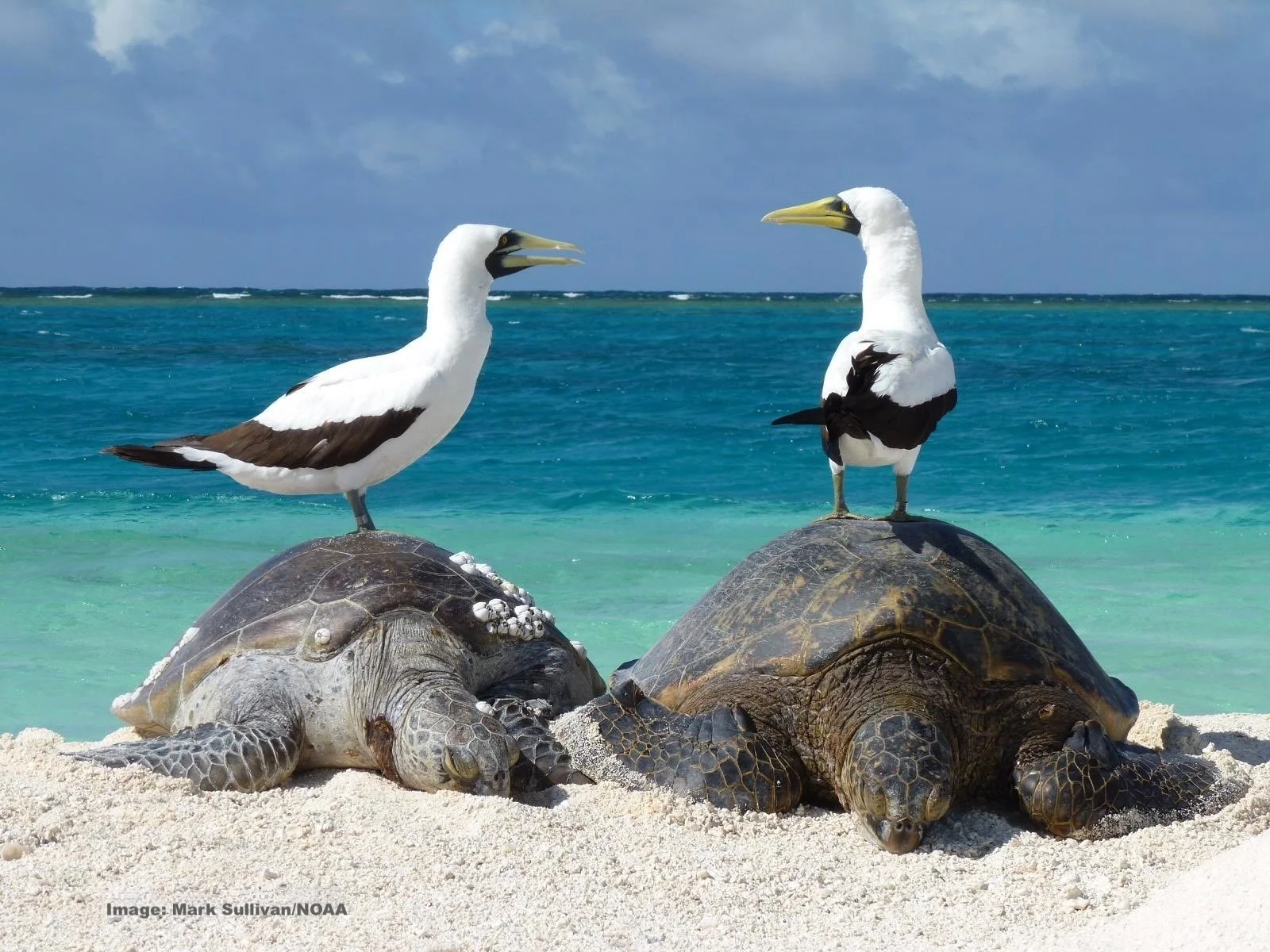
Two resting Green Sea Turtles make a convenient look-out point for two Masked Boobies, one of three boobie species found in Hawai’i. Image: Mark Sullivan for NOAA
Green Sea Turtle - Chelonia mydas
IUCN: Least Concern, downlisted from Endangered in 2025
Green Sea Turtle Significance in Native Hawaiian Culture
It is said that the hero Aiai created Honu when his drawing on a rock came to life, and that this connection with land is why sea turtles must leave the sea to nest.
Many deities take the form of a Green Sea Turtle, including Kanaloa, the god of the ocean and underworld, when he wishes to be among people. The god Ku (war, politics, and strength) could also take its form and wield its shell as a shield to protect the people from evil spirits.
But one Green Sea Turtle, named Kailua, would take the form of a little girl to protect Hawaii’s children.
Green Sea Turtle as Aumakua:
Green Sea turtles are a symbol of wisdom, good fortune, blessings, stamina, and harmony with nature. It is believed that Green Sea Turtles helped the ancients navigate the oceans and are the Aumakua of many fishermen and their families.
Green Seat Turtles haul out onto the beach. Hawaii’s Green Sea Turtles are one of only three populations worldwide to regularly rest and sun on land. Image: ©Heather Snow
Green Sea Fast Facts
Petroglyphs dating back from 400 to thousands of years attest to the Green Sea Turtle's cultural and mythological significance on the Hawaiian islands.
According to NOAA, the Green Sea Turtles (GST) that nest and feed in the Hawaiian Islands are a unique GST subset ( “Distinct Population Segment” or “Regional Management Unit”)
Hawaii’s Green Sea Turtles do not migrate or share any substantial genetic link with other Pacific Green Sea Turtles and are considered endemic to the islands.
Aside from Hawai’i’s, only two other GST populations (male and female) worldwide regularly come ashore to bask in the sun. The other two are in the Galapagos Islands, Ecuador, and the Wellesley Islands, Australia.
Best Times and Places to Look For Green Sea Turtles on Maui
The best times of day to look for Green Sea turtles are early morning (7-10 am) or late afternoon (3-5 pm) when they are likely to be basking on the beach.
You can see the turtles year-round, but May through September have the calmest waters for snorkeling.
The island of Maui is one of the world’s best places to see Green Sea Turtles. The best places on Maui are:
Turtle Town (Mākena, Malu’aka Beach) – perhaps the most visited (too many tourists!) spot for GST, the beaches, calm, clear waters, and coral reefs are a turtle haven.
Ho’okipa Beach Park (North Shore). For non-snorkelers, this is a great spot: the GST haul-out in the afternoon, sunning and resting on the beach.
Black Rock (Kā’anapali Beach) – This area has a lot of marine life, GST are seen swimming near the rocks.
Malu’aka Beach (South Maui) – Less touristy - quieter. Calm waters make for good snorkeling.
Hāhālua, The Manta Ray
Plankton is attracted to the light which then attracts Reef Manta Rays making for wonderful viewing opportunities. Image thanks to Anakela Tours
Hawaii is home to three of the world’s three Manta Ray species.
Reef Manta (Mobula alfredi) IUCN: Vulnerable
Giant Manta Ray (Mobula birostris) IUCN: Endangered
Oceanic Manta ((Mobula birostris) IUNC: Endangered
Manta Ray’s Significance in Hawaiian Culture
Manta Rays represent strength, protection, and healing, and are closely associated with the Hawaiian god of the ocean, Kanaloa. They are revered as deep-diving creatures that go beyond the realms of human reach.
The Hāhālua, or Manta Ray, in this case, a Reef Manta. Seeing mantas glide through the water, “wings” open wide, it is easy to believe that they are spirits. Image: ©Analekai Adventures
The Manta Ray as Aumakua
Their name, Hāhālua, means “two breaths” and refers to the Manta’s connection to both the spiritual and the physical worlds. The Manta Ray symbolizes ancestral wisdom, strength, and grace. Often, the Aumakua of fishermen's families is said to swim alongside their boats to protect them.
Manta Ray Fast Facts
1. Manta Rays have the largest brain-to-body ratio of all fish, and are thought to be able to identify themselves in a mirror.
2. Mantas are long-lived; one named Lefty lived over 40 years, but reproduction is extremely slow, with a single pup every two to three years.
3. The Manta Rays seen in Hawaii are usually one of the two reef manta species. The Big Island’s Kona Coast is famous for Manta Rays. About 130 Manta rays live in the waters off Hawaii’s Kona coast.
4. Manta Rays are not Sting Rays.
✓ Sting Rays are ocean bottom dwellers, often covering themselves with a thin layer of sand or mud. Mantas move continuously to breathe
and feed.
✓ Manta Rays are filter-feeders that harvest plankton by skimming the water with open mouths. Sting Rays hunt fish, crabs, mollusks, and
other marine life.
✓ Manta Ray tails do not have the Sting Ray’s venomous barbs.
The Best Times and Places to See Manta Rays in Hawaii
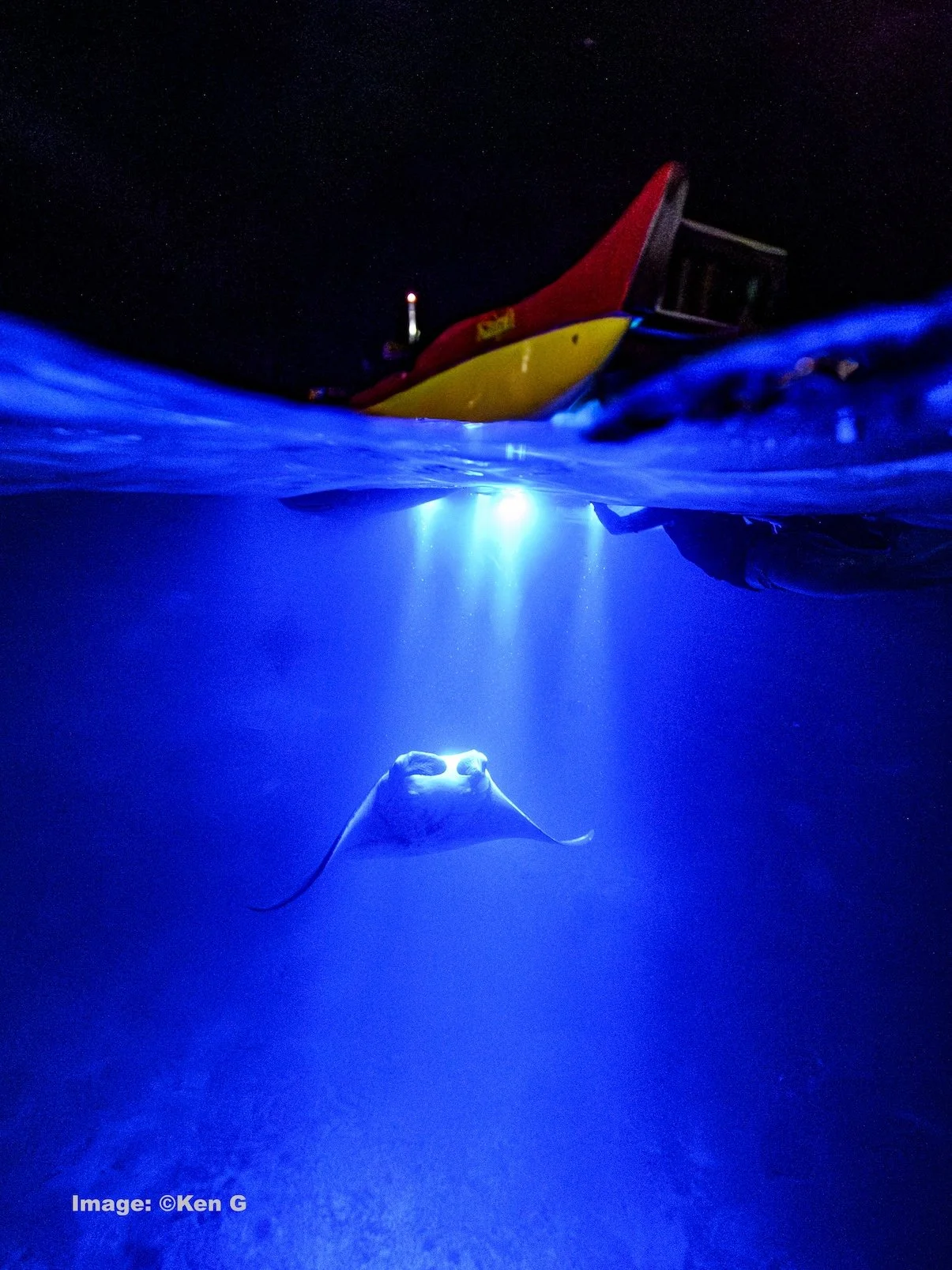
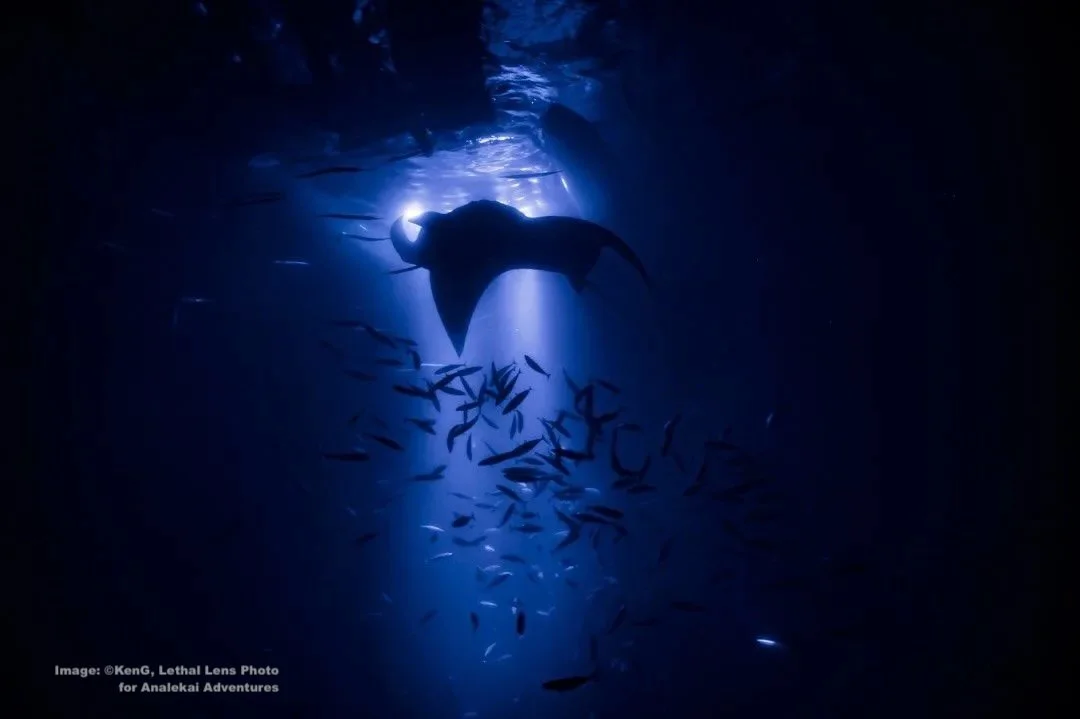
Manta Rays can be seen all year - but the summer months offer the calmest seas for viewing by boating or snorkeling. Night viewing is a "don't-miss” experience; however, its popularity is becoming a problem.
A Note on Manta Ray Viewing
In 2023, Hawaii Ocean Watch halted publication of their ”green list” of responsible Manta Ray viewing operators, explaining that far too many tourists - up to 400 per night - were in the water simultaneously, too many to keep them or the Manta Rays safe.
Manta are majestic but…
Always use a reputable guide and ask questions before you sign up. Stay well back from the Rays, no touching, no riding. No chasing.
We recommend Analekai Adventures. They use non-motorized paddle canoes and are an ADA accessible experience provider.
or swim to see Manta Rays with Manta Ray Advocates
Personal Note: If the Manta Rays are left alone, the curious animals will sometimes come to you. I had this experience personally in Miami when about eight wild Manta Rays swam toward me in very shallow open ocean water, surrounded me, and swam on, almost as if in slow motion. It was a magical experience that I will never forget. Could Manta Ray be my Aumakua?
Ilio-holo-i-ka uaua – Hawaiian Monk Seals
Monk Seal resting on Poi’pu Beach on the south shore of Kauai. Image: Ed Baily for Creative Commons
Hawaiian Monk Seal: Neomonachus schauinslandi
IUCN: Vulnerable
The Monk Seal’s Significance in Hawaiian Culture
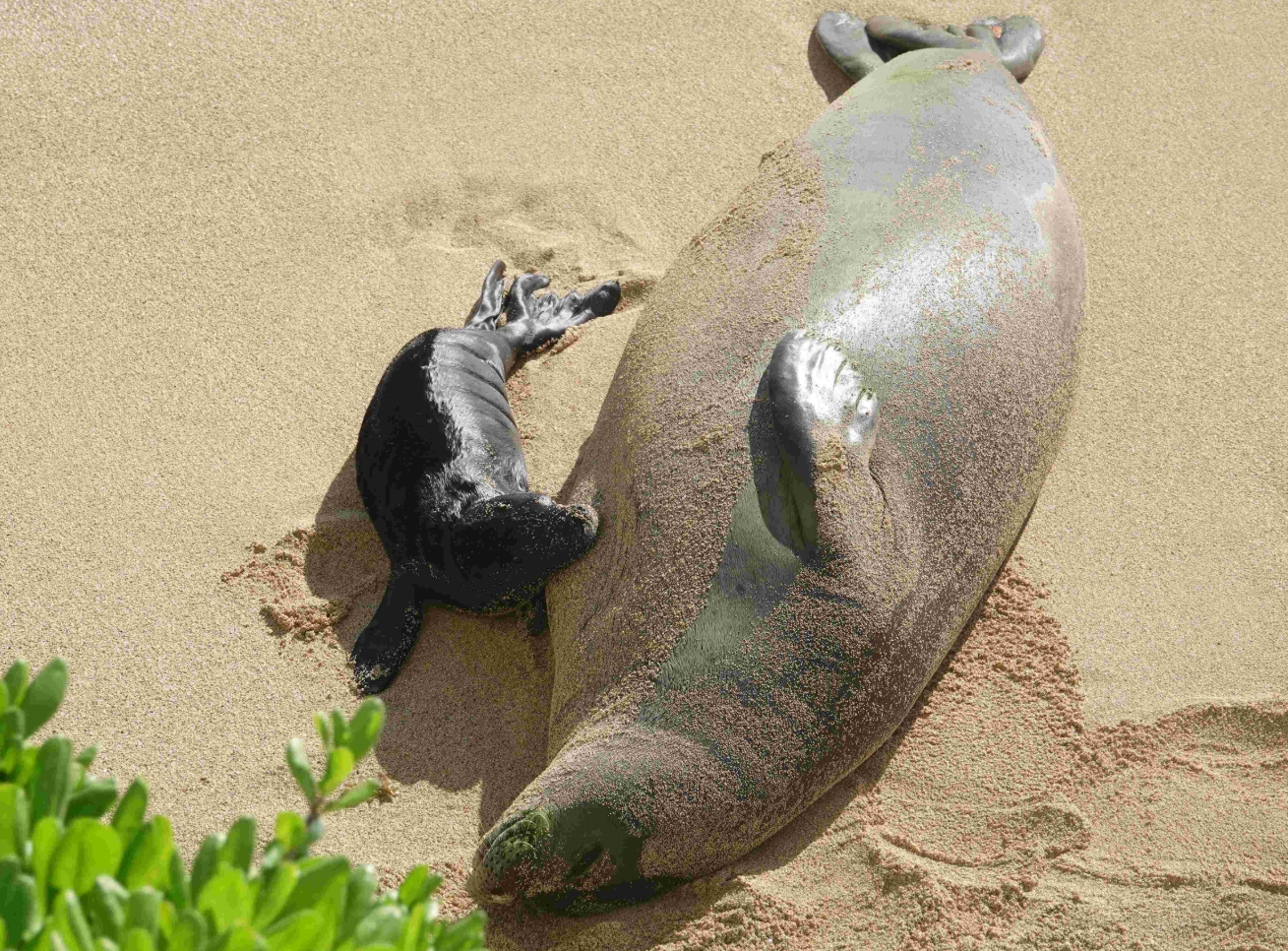
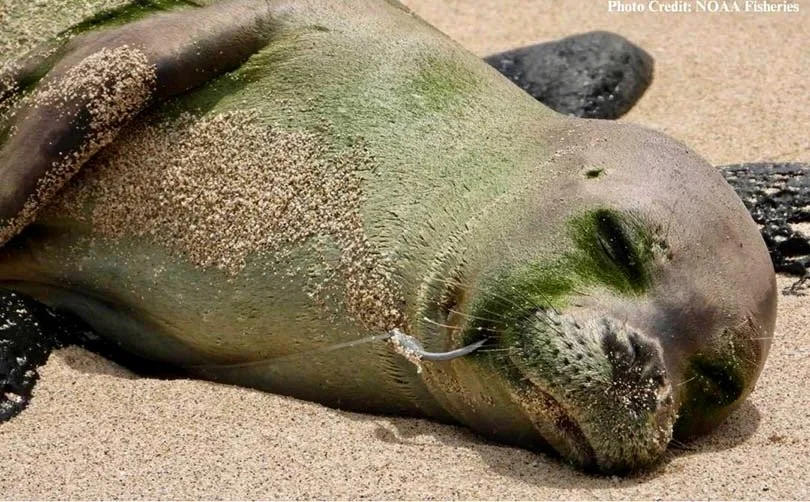
Their dog-like faces and effortless ability to swim in very rough seas give Monk Seals their Hawaiian name, ilio-holo-i-ka uaua, or Dog-that-runs-in-Rough-Sea. (The robe-like folds of neck skin and preference for solitude gave them their English name, Monk Seal)
The Monk Seal as Aumakua
Although Monk Seals are not mentioned as often historically as animals like Green Sea Turtles, Monk Seals are considered part of the Ohana (family, extended family, community) and are honored as Aumakua, protectors. The State’s official marine animal is the Monk Seal– could they be its Aumakua?
A Note on Monk Seal Conservation
Brought to the brink of extinction in the mid-19th century by seal hunting, the endemic Hawaiian Monk Seal is among the world’s most endangered species. According to NOAA, today’s population is approximately 1,600 individuals. About 400 Monk Seals are found around the main Islands and about 1,200 in Papahānaumokuākea Marine National Monument in the northwestern Hawaiian Islands.
According to NOAA, Monk Seals become entangled in fishing gear more than any other pinniped species. Climate change has added starvation and loss of terrestrial habitat to its list of survival threats. Rising sea levels and more frequent storms are shrinking Papahānaumokuākea, its main land environment.
Surprisingly, toxoplasmosis, a disease spread through cat feces, has also become a major threat to Monk Seals. This disease is thought to heighten risk-taking in wolves, another species regularly infected, but it is lethal to Monk Seals. Spinner Dolphins and several native bird species are also vulnerable to infection.
Monk Seal Fast Facts:
1. Monk Seals can look green. The seals, which spend considerable time foraging at sea, often at depths over 1000 ft (305 m), can grow algae on their coats. A yearly “catastrophic molt” exchanges the old fur for a new silvery coat.
2. Monk Seals are solitary; unlike other seals or sea lions, they don’t live in colonies. They will sometimes lie near each other but not touch.
The Papahānaumokuākea Marine National Monument, formally established in 2006, a 1,350 mile stretch of collection of coral island, shoals etc, that support a divrse array of marine life and sea birds, many of which are rare, endemic, or endangered - including the Monk Seal.
Best Times and Places to see Monk Seals
Monk seals are more likely to be found on the beach during pupping season, March through August.
The Papahānaumokuākea Marine National Monument is a collection of small uninhabited islands with a huge diversity of marine and avian life - . Unfortunately, the current US administration’s funding cuts have made tourism impossible; however, we hope it will resume in the future.
On Maui, check out Ho'okipa Beach and Ka'anapali Beach (near Black Rock)
Kauai Is known as the best island for sightings, check Po’ipū Beach, Mahaulepu Beach, and the Napali Coast.
Koholā, The Humpback Whale
Koholā - the mighty Humpback Whale is a caring mother and one of the native Hawaiian people’s Aumakua, spirit guides and protectors. Image: ©Wirestock
Megaptera novaeangliae IUCN: Least Concern
The Whale in Hawaiian Culture
Koholā are a symbol of Ha – or breath. Breath is life. When the koholā exhales its plume into the sky, it is a reminder of life's importance. The Koholā are also revered as a manifestation of Kanaloa, the god of the ocean, and exemplify mana, the intangible strength and power that is its spirit.
Traditionally, koholā is the name used for whales in general, including Humpback Whales. In modern Hawaii, the term kuapi’o, meaning “humpbacked” or “arched”, has given rise to a new name: kuapi’o koholā – literally, “humpbacked whale.”
Koholā, the Whale as Aumakua
The huge, quiet whales are revered as “deep seekers” who travel great distances. They are considered bold but gentle giants and good caregivers.
Koholā, the Humpback Whale breaching near Lahaina on Maui. Image ©Manuel Balesteri
Humpback Whale Fast Facts
Their Song Saved Their Species
Over 50,000 whales per year were killed during the 1950s and ‘60s. By 1965, only 1,000 to 1,400 individuals were estimated to survive in the North Pacific.
“Song of the Humpback Whale”, released in 1970 by bioacoustician Roger Payne, sold over 100,000 copies and was instrumental in the 1972 UN Conference on the Human Environment’s ten-year moratorium on commercial whaling.
Today, over 12,000 Humpback Whales, representing about half of the total North Pacific population, migrate over 3,000 miles from their sub-arctic feeding grounds to Hawaii’s warm waters, now protected as the Hawaiian Islands Humpback Whale Sanctuary, to breed, calve, and nurse.
Modern research credits Humpback migration with helping ancient Polynesians discover the Hawaiian Islands.
Humpback whales have the largest pectoral fins of any whale, each is individual and is helpful in identification. This is an adult and calf in Hawaii. Image: ©Manuel Balestri
Best Place and Time to See Koholā, Humpback Whales
Best Time: November – March, with mid-February to mid-March considered peak. Early morning, when the water is calmest, is the most comfortable and easiest time to spot whale activity.
According to The Hawaii Wildlife Fund, humpbacks prefer two major areas:
1) The four-island region of Maui, Molokai, Lanai, and Kaho’olawe, and
2) The Penguin Bank, a tongue of shallow water formed by a submerged volcano extending 25 miles southwest of western Molokai that is part of the Hawaiian Islands Humpback Whale National Sanctuary
Maui may be the best of the Hawaiian Islands to see Humpback whales.
The Auau Channel, separating Maui from Lanai, acts like a cradle for newborn calves. It is only 200 – 600 feet deep, enough for adults to swim freely, but shallow enough to protect the calves.
From the shore at the Wailea area in South Maui, where the calm water makes spouting and breeching easy to see.
By boat tour from Mā alaea Bay in the northern end of the channel or from Lahaina Harbor in West Maui.
Other Islands: In the last decade or so, they have spread to the Big Island, Kauai, and Oahu, between Koko Head and Sandy Beach, and to the North Shore.
Manō - Sharks (Tiger Sharks)
Manō - The Tiger Shark, the Hawaiian people’s spiritual connection to the great fish has manifested in some of the best conservation laws on the planet. Image: ©Stefan Pircher
Galeocerdo cuvier IUNC Near Threatened
Manō or Sharks in Hawaiian Culture
Sharks are a very powerful symbol in Hawaiian culture. It is said that in ancient times, the shark god, Kamohoali’I, led his sister Pele, goddess of the volcano, in a voyaging canoe from Kavi’iki, the ancient homeland, to Hawai’i.
Today, the people’s deep spiritual connection to sharks has manifested into the world’s strongest shark protection. Hawai’i prohibits commercial and recreational shark fishing, and was the first state to ban the shark fin trade and enforce shark fin trafficking laws.
Sharks as Aumakua
Many shark species can be Amakua, but the most common is the Tiger Shark.
Tiger sharks were considered formidable protectors and often associated with guidance, strength, and vigilance. Fishermen with the Tiger Shark Aumakua welcomed the shark when it appeared and believed it led them to places where they would catch fish.
Tiger Shark Fast Facts
Ocean Garbage is a great threat to Tiger Sharks, which will eat almost anything, including a car’s license plate found in one Tiger Shark’s stomach.
The stripes that give the Tiger Shark its name all but disappear as it matures.
Best Time and Places to See Tiger Sharks
The Best Time to See Tiger Sharks: Late Summer through Early Winter
The best places are Kona on the Big Island: Manta Ray Bay or Honokohau, Oahu on the North Shore is also a good Tiger Shark spotting destination.
Explore Hawai’i
The Hawaiian Island of Maui is a magic place where, with open eyes and heart, you may easily encounter Aumakua - spirit protectors - in the water and on the shore. Image: Billy McDonald
The marine life in Hawaiian waters is varied, fascinating, and rich in cultural insights. For the best experiences, take a tour with an experienced guide and tour operator. Choose those that practice responsible, sustainable viewing and can provide insight into the animal’s cultural relevance. The more you understand about the Hawaiian culture, the more you will enjoy its amazing and beautiful nature.
Come explore Hawai’i, and let its waters reveal your personal Aumakua.
We want to hear from you. Let us know below if you enjoyed our story.