The Best Winter Wolf Watching in Yellowstone! To Benefit the Wolf Conservation Center
Photographing wolves in the wild requires luck (which we had!) and long-range photography lenses; (which we did not have). This magnificent Yellowstone wolf was photographed by Dan Stahler, NPS.
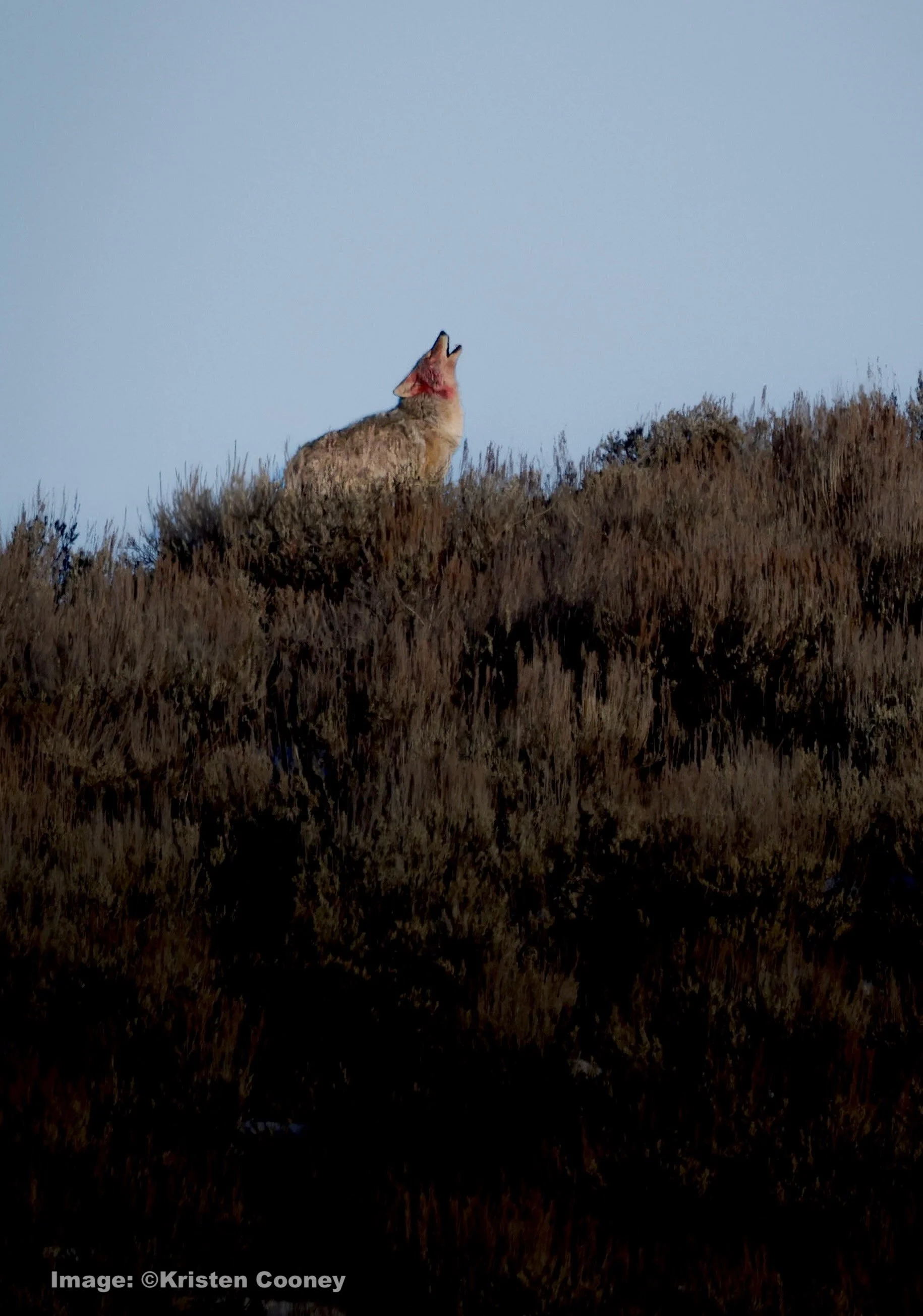
Coyotes Send a Message on the Breeze
Roberta Ktavette
We walked, single file, up the roadside without a word. Only the wind blowing across the frozen hills moved in the thin, cold air.
A lone raven appeared and flew up over the hills to the west.
Cara, our guide, froze…then motioned for silence. There! Carried on the breeze, something.
Then … nothing. We didn’t move.
And there again! A Yip, Yip, Yiping, followed by a chorus of high-pitched whining howls, reached us, from somewhere to the left and beyond. We looked up.
The chorus continued for a few minutes – and stopped.
Coyotes were announcing the presence of wolves!
Once more, the chorus began – then again, silence.
Sunrise on Electric Peak. The day began cold and dark but as we watched, the mountain began to glow - and so did the day. Image: ©Kristen Cooney
Our Annual Celebration of Wolves and More For Wolf Conservation
Trip Tips
What: Winter Wolf Watching and Learning in Yellowstone
When: February and March
To Benefit: 10% of ticket cost is donated in your name to The Wolf Conservation Center
Details: ✓ 2 Small Groups
✓ Private presentations by scientists, researchers, etc.
How: Meet in Bozeman. Meals, accommodations, etc. included.
This February and March, we celebrated the fourth year of our annual Winter Wolf Watching and Learning in Yellowstone expeditions. Like all our small-group experiences, these, our eighth and ninth trips for the Wolf Conservation Center in South Salem, New York, raise money for a conservation-missioned organization’s work, in this case, wolf research and conservation.
Over the years, our annual Yellowstone expedition has become an international wolf-love celebration. This year was no different, with guests joining from Bangalore, India; London, England; Manitoba, Canada; Atlanta, Georgia; Vermont; Pennsylvania; and New York. Among them were a biologist, a trader, a woman in finance, a contractor, three business owners (a pet rescue center, an integrated marketing company, and a sanitation business), plus a pre-school volunteer.
Every guest, no matter where they come from or who they are, has one thing in common: a passion for wolves. It’s a passion we share.
Every guest, no matter where they come from or who they are, has one thing in common: a passion for wolves. It’s a passion we share.

Let’s Go For a “Little Walk” to Find Wolves
From somewhere unseen, the coyotes howled once more. Cara, said, “Let’s go for a walk.”
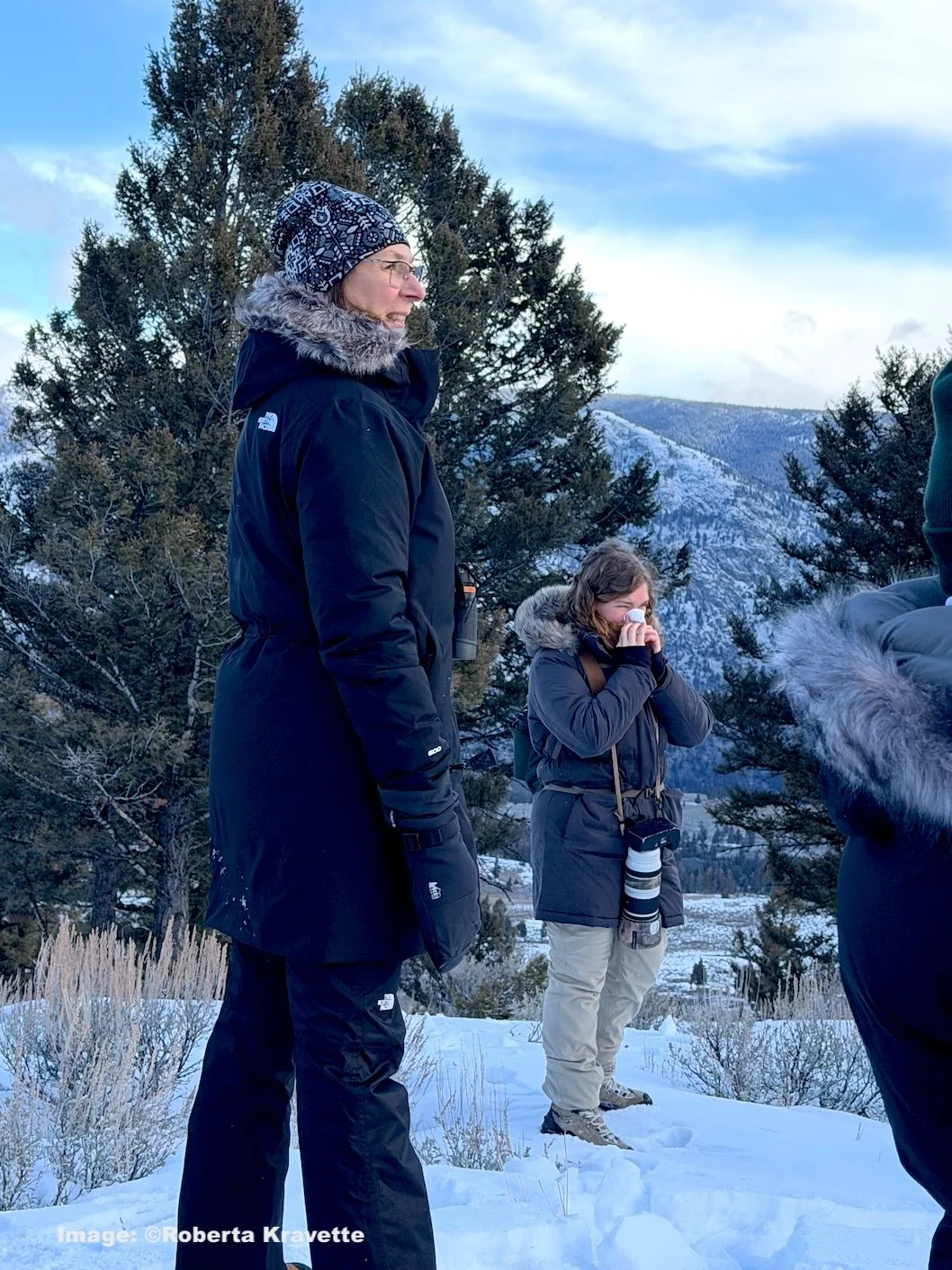
This is not a hiking trip; and its winter, when conditions can change in an instant, so most of our wildlife watching is from the road, where everything from Big Horn sheep to wolves to Golden Eagles can be found and watched, but everyone in our group was pretty fit, the sky was clear, and on our last day, we were game for a little stroll, so…
Bundled against the cold, Yaktrax affixed for traction, we started out and up, single file across the frozen land.
Wolves in the wild are not easy to find; they will know you have arrived way before you spot them. If you spot them. Seemingly invisible, they will check you out then fade into the trees without making a sound. Unless they are in Yellowstone!
There, wolves keep a substantial distance from humans but live relatively openly. Unlike wolves elsewhere, many Yellowstone wolves are habituated – or used to – the hordes of harmless wolf watchers who, hoping to catch a glimpse of wild Canis lupus, descend on the Park each spring through autumn since their reintroduction in 1995.
But in February and March, the time when we are in Yellowstone, the Park is at its coldest and (usually) snowiest. The hordes are gone, and our “company” on the ledges or pullouts consists mostly of research teams and a few passionate wolf followers scanning for grey or black movement in the white expanse along the tree line and open grasslands.
How Easy is it to Spot A Wolf in Yellowstone?

Contrary to popular belief, wolves are few in Yellowstone; even in their best year, the entire wolf population has never exceeded 200 and has hovered between 80 and 120. Compare that to 4-6,000 bison and an equal number of elk that winter yearly in the Park.
In the 2025- 2026 breeding season, disease, probably distemper, wiped out all the year’s pups but one, and legal hunting and poaching took a toll on the adults. Yellowstone’s wolf population is only somewhere between 70 and 86 wolves at this writing, spread out over the Park’s 2.2 million acres or 3472 sq. miles
Spotting a wolf – or any wildlife is never guaranteed. But the search always turns up some wonderful wildlife surprises.
We were watching this lone bull Bison walk along the tree line when we realized he was not alone, a red fox was walking with him, sometimes in front, sometimes at his side or behind. They walked together, in peace. Image: Ed Ballings
Our group “walked” on.
Up the hill we trudged, al last, breathlessly, reaching the top. Our guide (carrying scopes!) kept walking. Cara crossed the plateau and trekked over the next rise ... and then the next. We followed, breathing hard.
By the time we stopped at the fourth plateau, we were at well over 7000 ft., and our vehicle was a tiny speck in the distance.
A few folks from the Yellowstone Wolf Project were already there, watching and documenting the action, including one intrepid researcher who climbed onto a lichen-frosted boulder for a better look. They told us that a pack had made a kill at dawn, “just over there...” among the trees.
We had found the wolves! Joy!
For an hour, through the scopes, we watched the Rescue Creek pack. Some members rested after their big meal; others played or stretched, and it seemed there was always someone alert and keeping a watchful eye on the scene.
Finally, sadly, it was time to trek back.
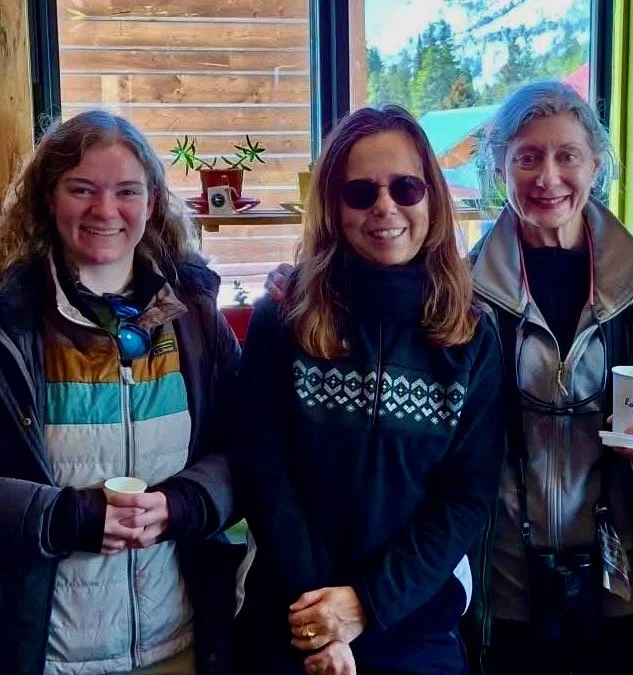
After our “little walk.” Our Destination: Wildlife leader, Kristen Cooney, is wearing glasses against the glare, Sara in the middle, our guide, Cara McGary helping us with the “selfie”, that’s me, Roberta, behind her, and Fabiola, Ed, Denise, and Di. Image: Roberta Kravette via Cara’s expertise with ‘selfies.”
Watching Wolves in Northern Yellowstone and the Lamar Valley
This clever coyote grabbed a prime piece of a recent wolf kill, then ran straight for the three vehicles that stopped to watch -wolves would not follow. Down the road he trotted, with all of us cheering him on. He kept an eye on us and an eye out for predators and thieves (ravens!) - staying in front of the slowly moving vans, until he found a safe hiding place to enjoy his meal. Image: ©️Kristen Cooney
The territories of the two largest packs, today: Rescue Creek and Junction Butte, each with about 15 members, range across the Lamar Valley, between the Gallatin Mountains to the west and the Absaroka to the east, with the Yellowstone River winding its way between, and the only road open at this time of year running alongside. This is where elk and deer traditionally gather to winter.
But the climate is changing. What was traditionally -20F was this year hovering around +20F to +32F. And, except at the highest elevations, the heavy snows never came. Those conditions allowed elk to roam farther from the road – and the wolves followed.
The warmer than normal temperature gave these Bison a little spring fever in February! Video taken with my phone from inside the car. Roberta
Still, we had wolf sightings: On our first morning, we found the Rescue Creek pack curled up among the trees, bedded down. On another day, we caught up with the Junction Buttes chasing an elk into the forest. One morning, we found a young wolf, harassed by ravens, gulping the last few mouthfuls of a kill after the older ones had trotted off. We later saw them again, sleeping. And of course, from our “walk’s” 7,000 ft vantage point, we watched a few members of the Rescue Creek Pack tossing a bone in play. The rest were… sleeping.
Do you notice a trend here? Wolves predominantly hunt in the evening or at dawn. During the day, especially when the year’s pups are old enough to (mostly) stay out of trouble, wolves like to bed down and sleep, fully aware and unconcerned by the excited humans watching from the hilltop or roadside.
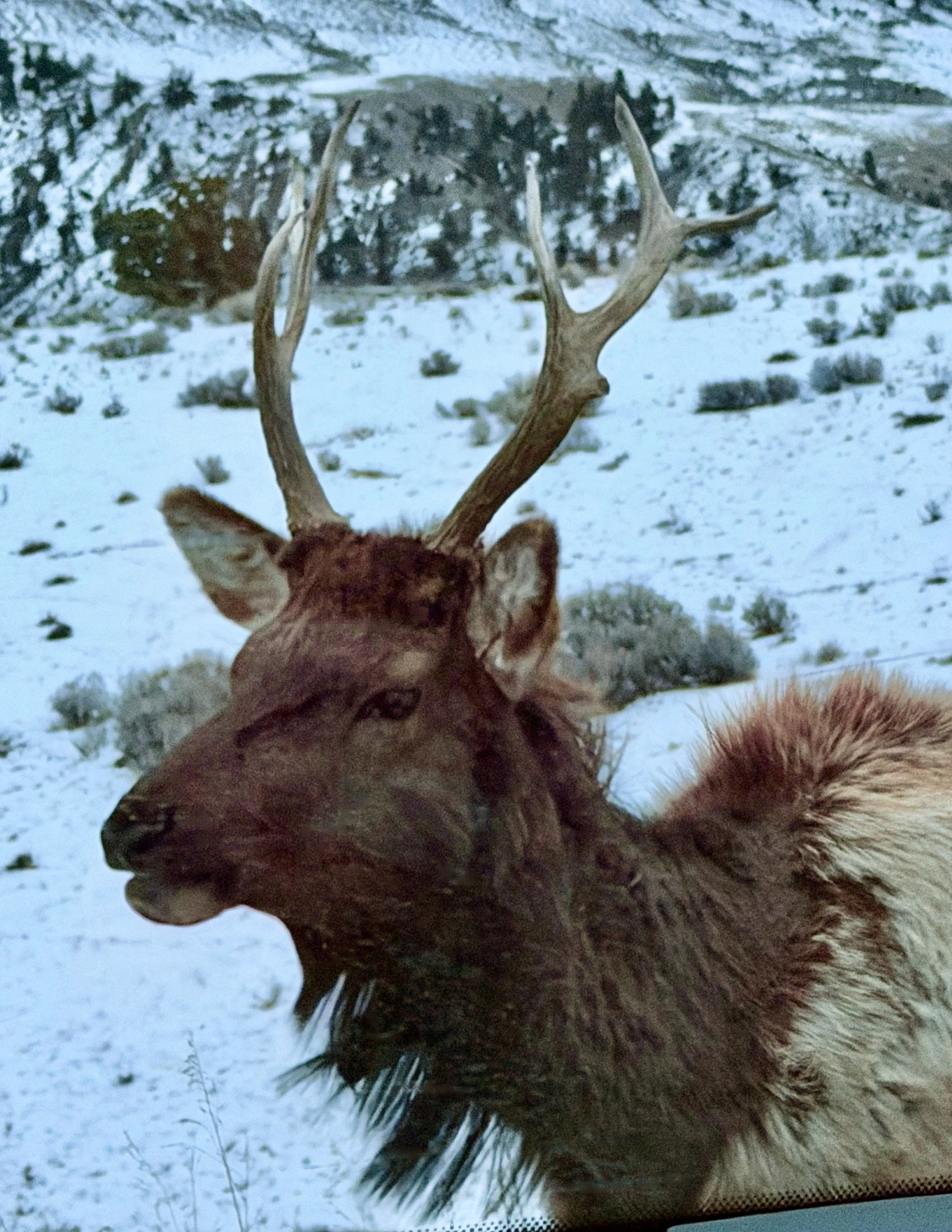
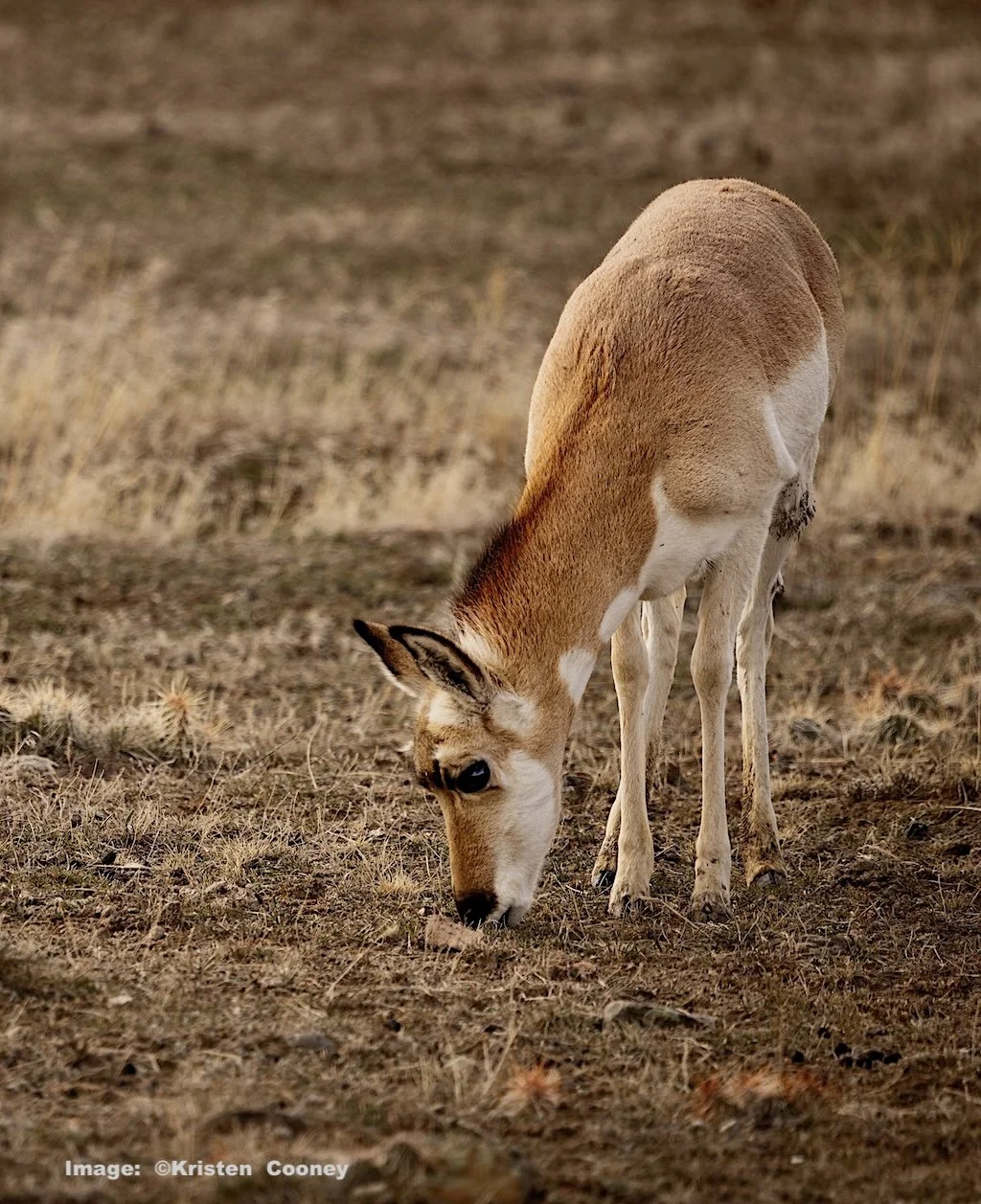
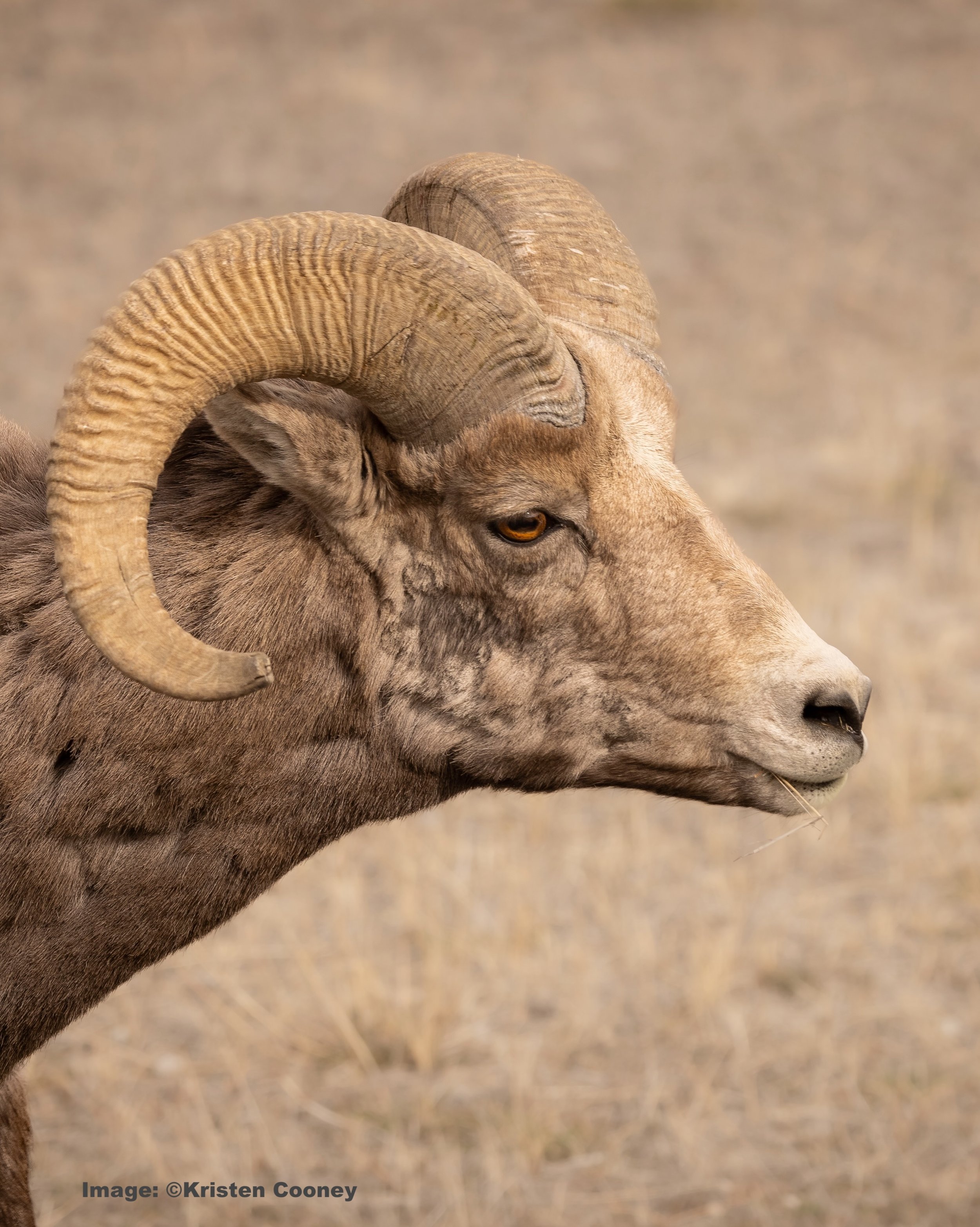
Lucky for the wolves – and wildlife-viewing visitors - wolves have great neighbors: Bison, Elk, Mule and White-tailed deer, Pronghorn (the fastest animal in North America), Big Horn sheep, and Mountain goats, to name a few. In our quest to find wolves, we saw them all!
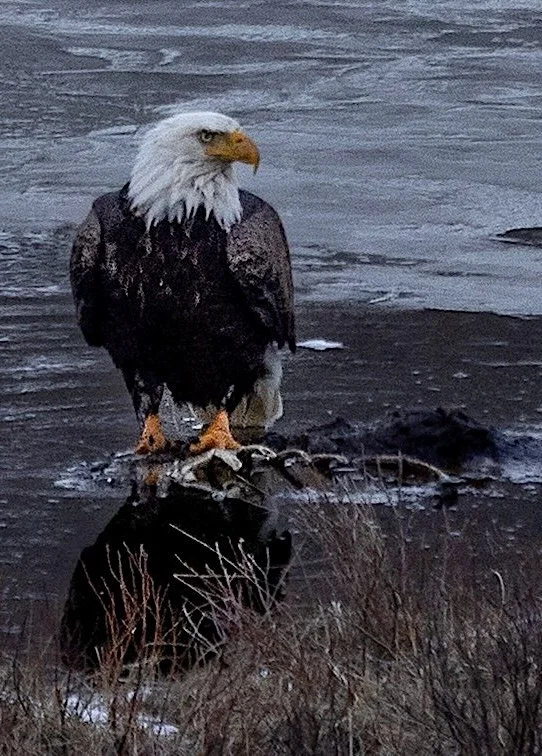
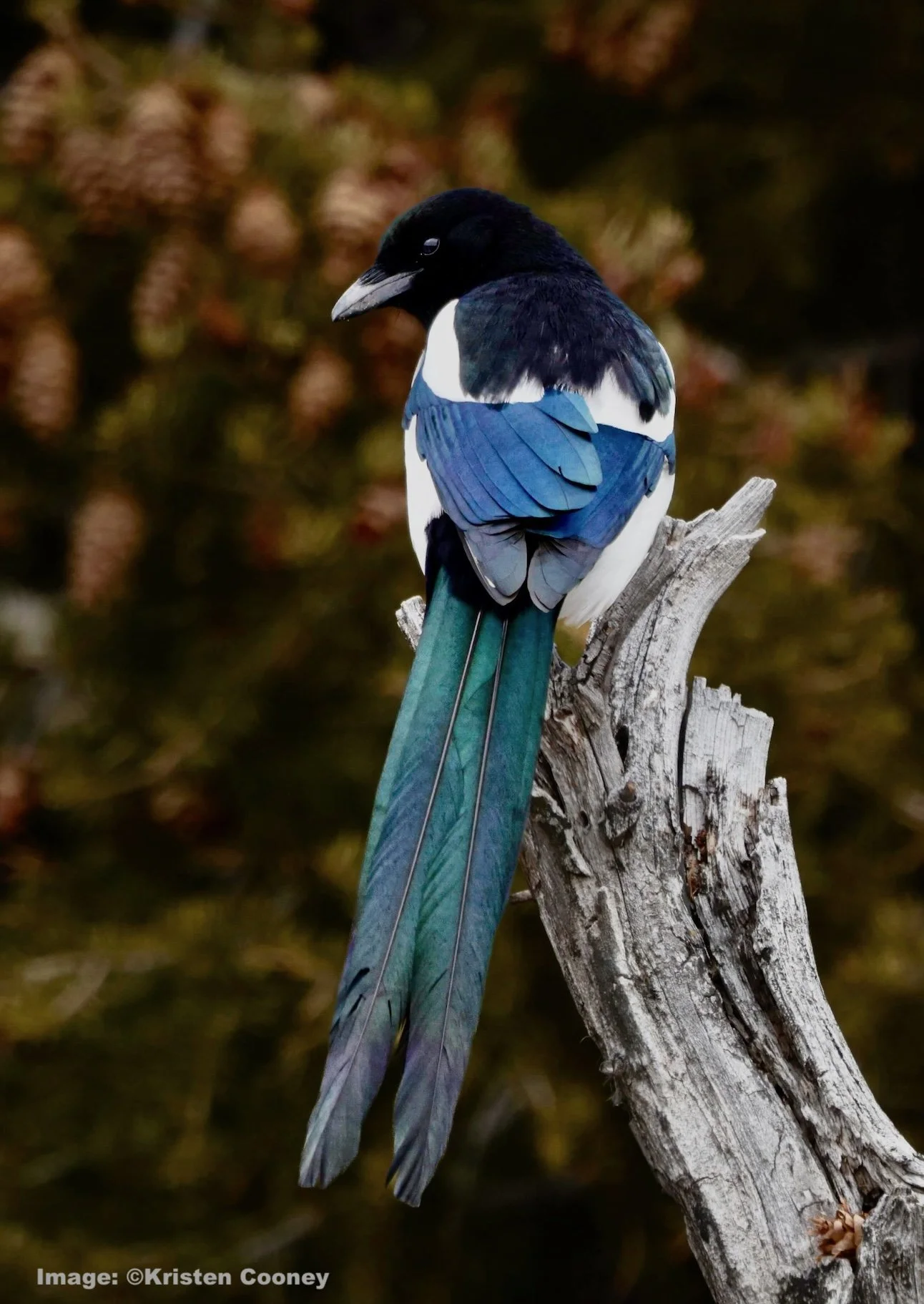
Above us, Golden and Bald eagles soared, ravens called, and Magpies teased, and in the river, Common Golden-Eye ducks dipped and dived into the half-frozen river.
Understanding What They Are Doing Makes Wildlife Watching More Fun.


Each night before dinner, we have a private presentation with an expert in the field. This year we met with Kira Cassidy for “Yellowstone Wolf Research Update”, Clair Lacy gave us the inside scoop with, “Boots on the Ground: Lessons learned tracking Wolves & Cougars in Yellowstone”, George Bumann taught us to “speak” raven, coyote, and more with “Communication with Animals,” and Dr. Jim Halfpenny brought the wolves “home” with “The Genealogy of Yellowstone Wolves.”
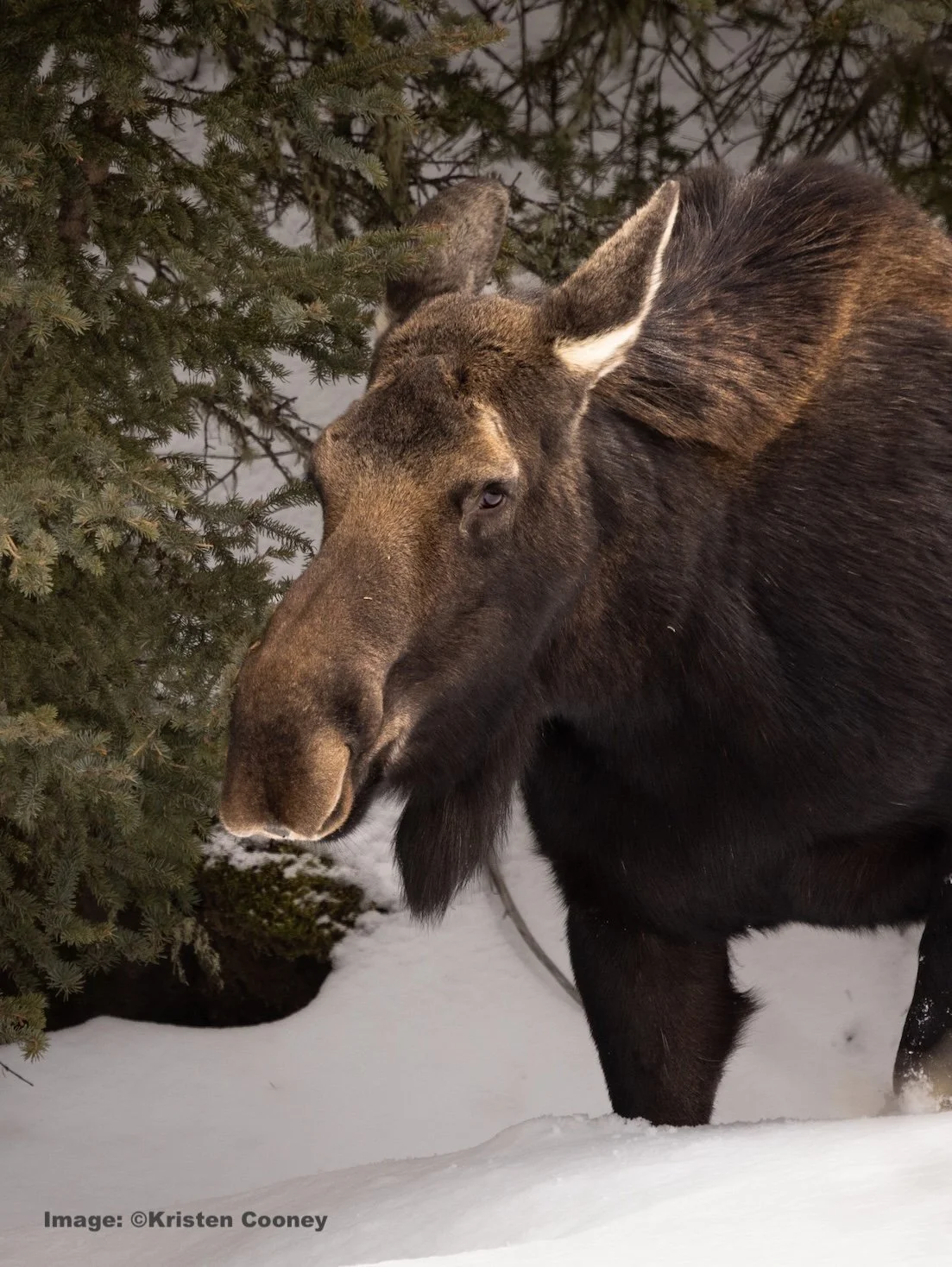
Finally, after a week rising to star-filled skies, following ravens following wolves, decoding coyotes, marveling over Moose in the willows and Big Horn on the mountains, biding our time with Bison, and learning from the experts, it was time to head back to Bozeman and home.
Love them or not, wolves inspire deep emotion. Our farewell dinners are always bittersweet affairs, with laughter and tears. This year was no exception.
What the Wolves Taught Us
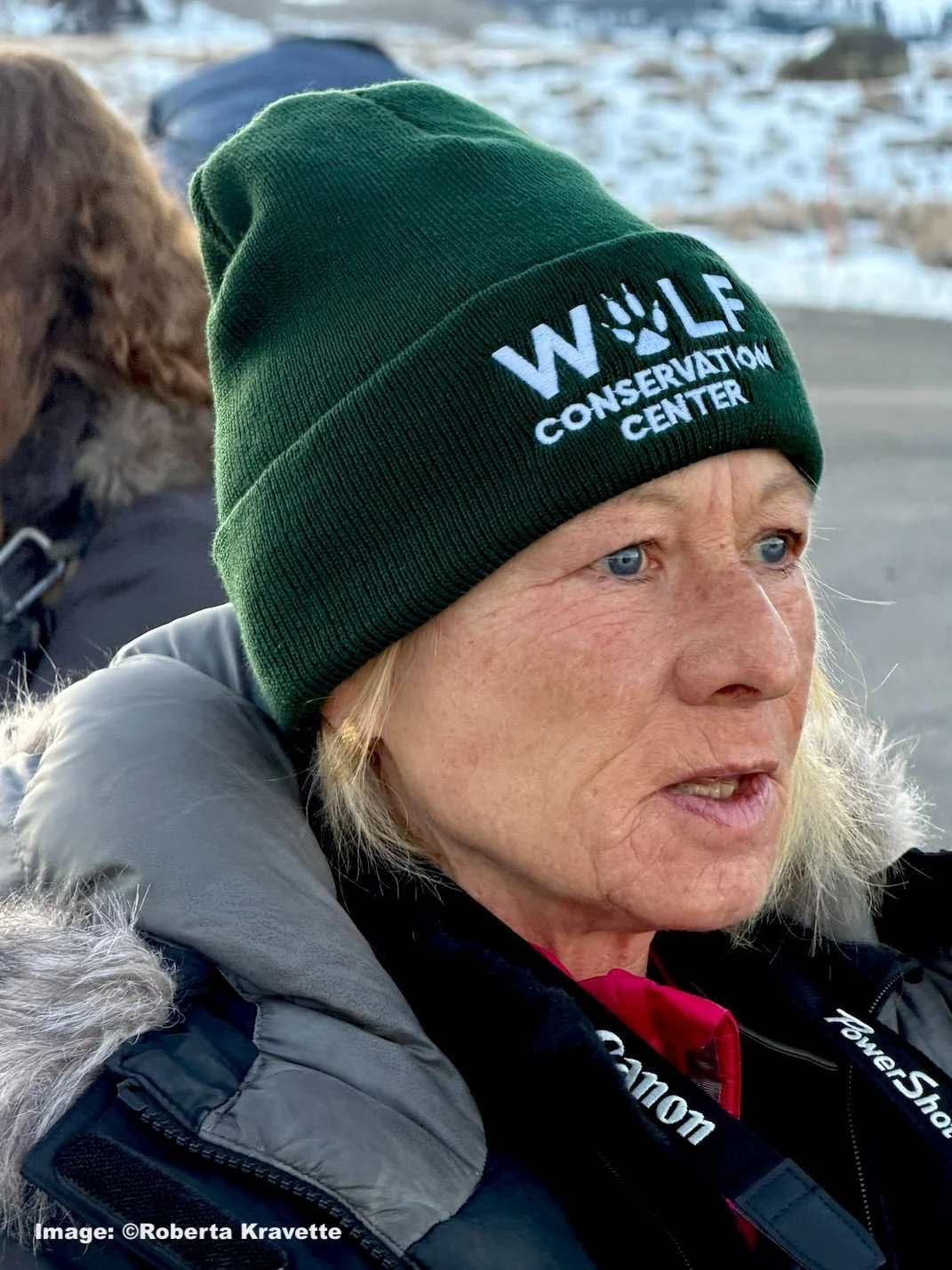
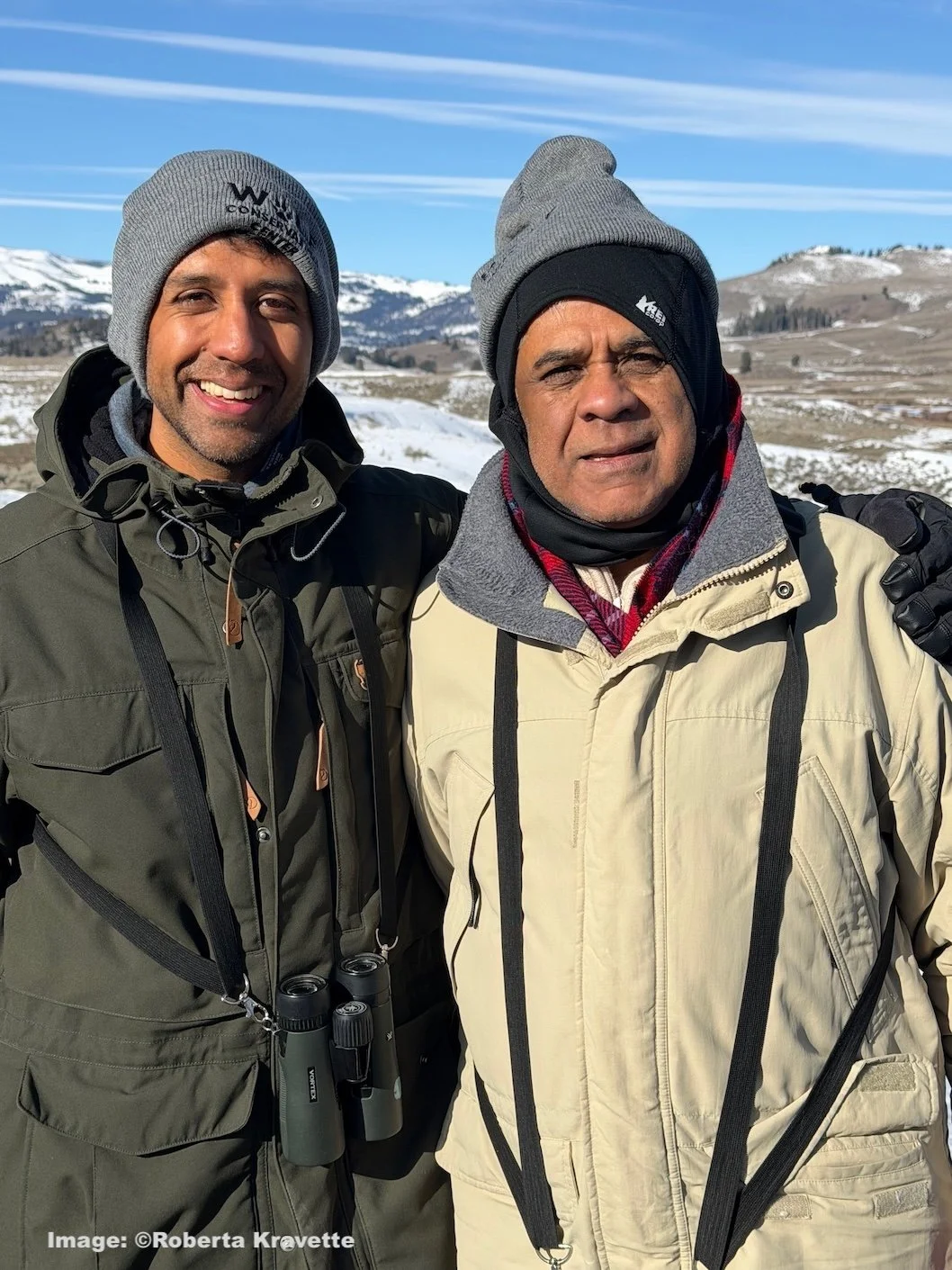
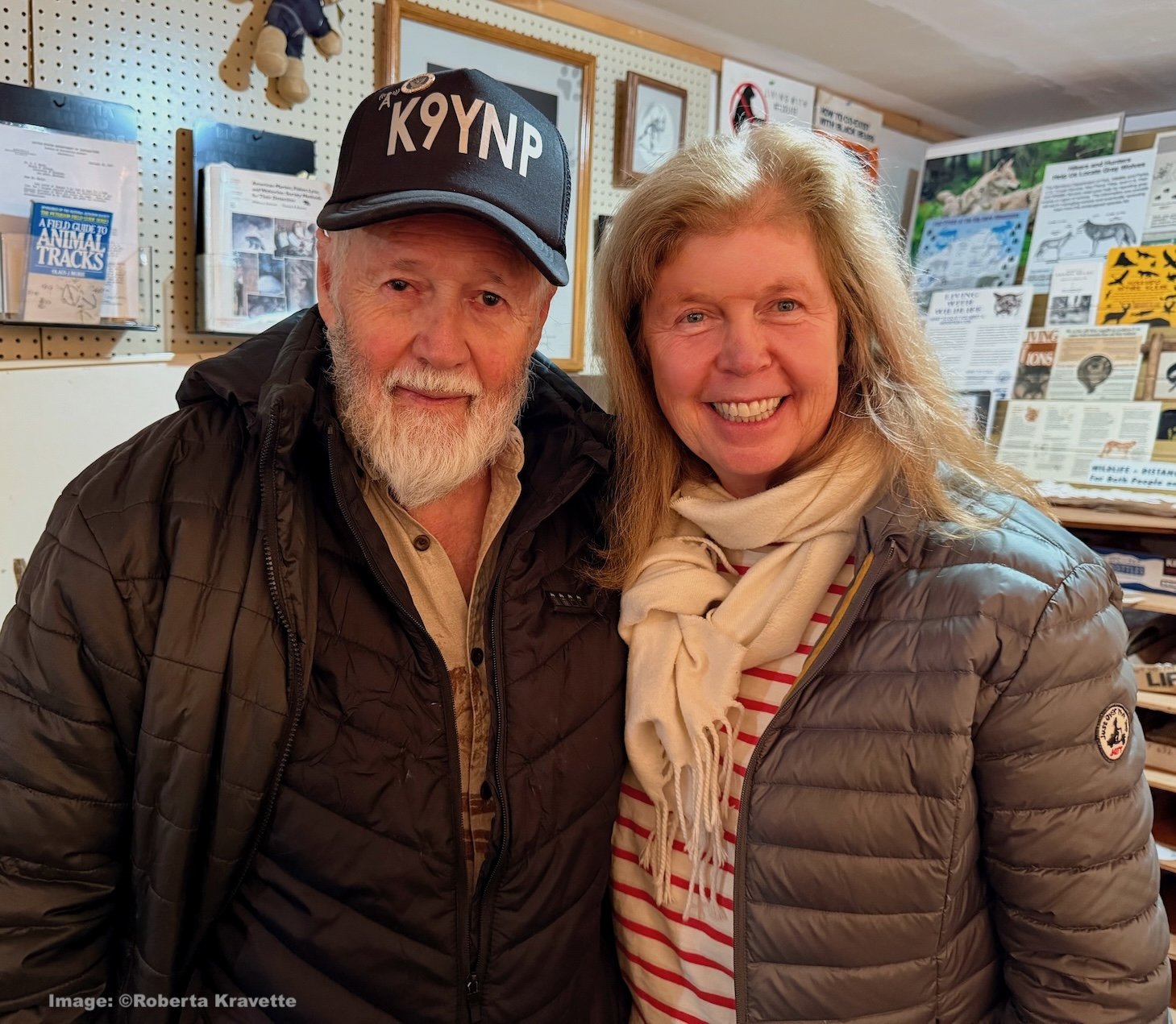
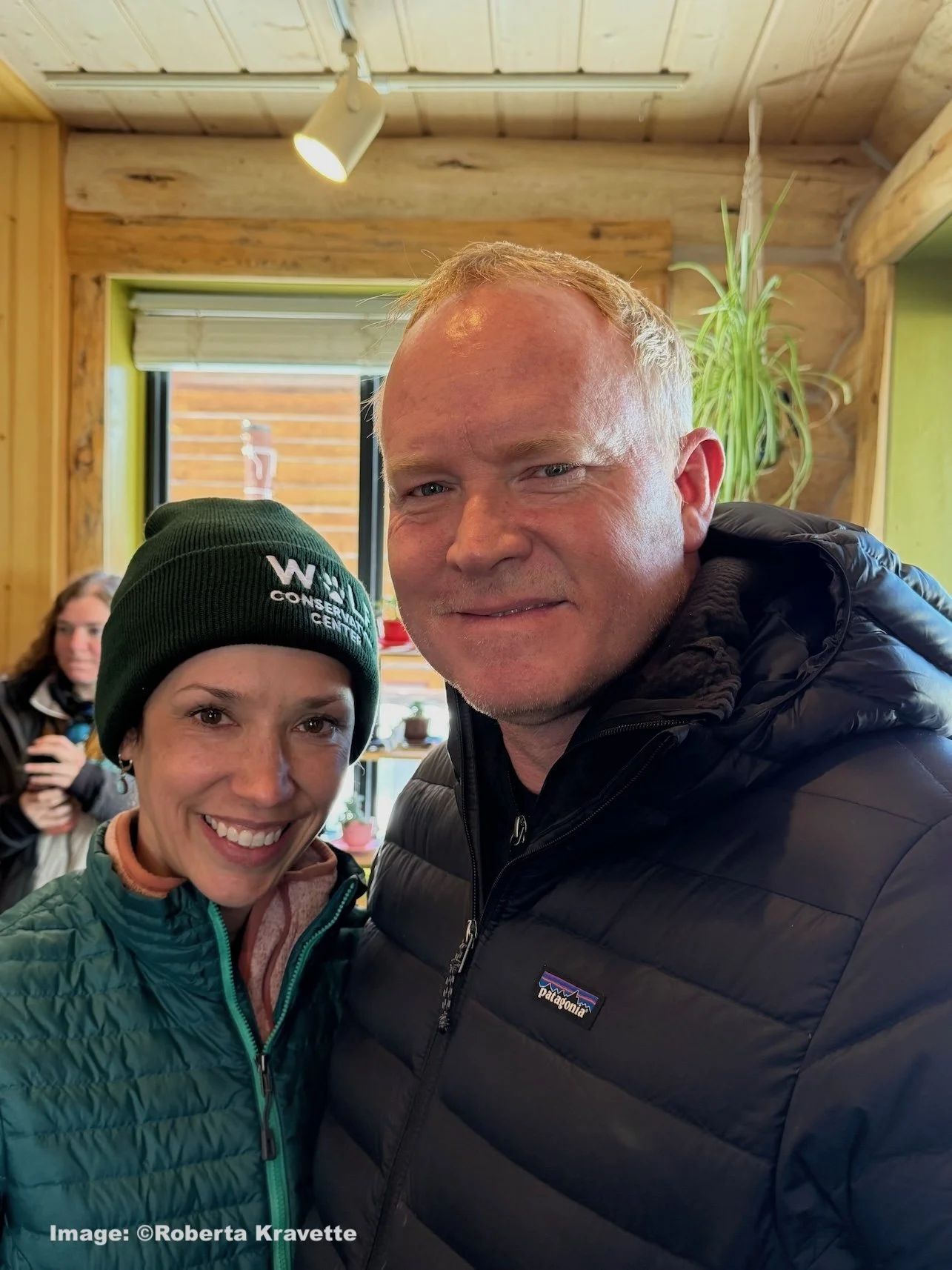


Wolves are an interesting species. They take care of each other, protect each other, play together, and work together. They live as families do, each having their niche in the pack. Over time, it is easy to discern personalities – The parents, the cut-up, the caregiver, the flirt, the decision-maker, the protector, the patient, the impatient ones, and the one who always seems to rise above itself in times of need.
No two wolf packs or wolf watching experiences are ever the same – except at the end, when just about every Guest realizes that something has changed. Funny how watching wolves in winter can touch a point deep in the human heart.
You will never forget your winter wolf-watching and learning experience in Yellowstone.
The Best Way to See Yellowstone Wolves in Winter
Seeing wolves in the wild, even in Yellowstone, requires luck, patience, perseverance - and a plan. The information below can help - or join us on our next expedition! Image Jeremy SanderRaj, NPS
Fly into Bozeman, Montana.
Call Rob, the owner of Bozeman Airport Taxi, in advance to arrange a ride to your hotel. His drivers are on time and will be waiting just outside the baggage claim for you. Rob has never let us down.