
Six Spectacular Winter Owls You Can See in Minnesota + Where to Find Them
Why Minnesota is North America's Premier Winter Owl Destination
Roberta Kravett, Co Founder
Every winter, something magical happens in Minnesota. At the moment when many of the state’s humans (and birds!) head south to escape the cold, a group of intrepid owls, raptors, and songbirds from the North will arrive to spend the winter. These birds think northern Minnesota’s sparkling snow and cold temperatures are just perfect. They have journeyed south from their breeding grounds in Alaska, Canada, and the Arctic, some traveling hundreds of miles to reach Minnesota’s boreal forests, bogs, and grasslands, and there they stop…adding avian allure to Minnesota’s winter wonderland.
The Great Owl Irruption of 2025! Last winter (2025), one of the most spectacular owl irruptions in recent history brought record numbers of the magnificent raptors (and raptor lovers!) to northern Minnesota. Great Gray and tiny Boreal, distinctive Northern Hawk owls – and even Snowy owls arrived in numbers that have not been seen since 2004. The owl influx created unparalleled viewing opportunities for people who love owls – we hope for a repeat this winter! (See below for Owl Irruption MYTH BUSTER!)
Winter in the Saz-Zim Bog is a wonderland of frosty snow, clear blue skies and wintering owls and other Arctic breeding birds. This is the Warren Woessner boardwalk. Image: ©Gerald D Tang
For birders and wildlife photographers, Minnesota’s winter landscape offers something truly special: the chance to see six stunning owl species in their natural habitat, against pristine snow-covered backdrops. Whether you’re looking to check owl species off your life list or simply want to experience these quintessential birds of the forest, Minnesota is the place and winter is the time!
The Magnificent Six: Minnesota's Winter Owls
When it comes to owl watching in Minnesota, these six species represent the crown jewels of winter birding. Each brings unique characteristics and viewing opportunities that make Minnesota winter owls among North America's most sought-after wildlife experiences.
1. Great Gray Owl – The Phantom of the North
A Great Gray Owl hunting in the Sax-Zim Bog in Minnesota. Image by ©Josh Galicki
Great Gray Owl Fast Facts:
Strix nebulosa
✓Conservation Status: Least Concern, for now
✓ Length: 24-33 in (61-84 cm)
✓ Weight: 24.7-60lbs (700-1700gm)
✓ Wing Span: 53.9-60.2in (137-153 cm)
✓ Night hunter, and dawn and dusk
Why They're Special:
Birders and owl lovers from all over the world come to Minnesota in winter for a view of the Great Gray Owl - and for good reason! At up to 3 feet tall and with piercing yellow eyes, North America’s tallest owl, the Great Gray Owl, is a formidable fellow.
Great Gray Owls are night hunters, flying silently over meadows and grasslands at the forest edges. Their distinctive facial disc acts like a satellite dish for detecting prey. Despite their impressive size, these owls are surprisingly lightweight—most of their bulk is dense feathers protecting them from brutal northern winters.
What Brings Great Grays to Minnesota:
When the temperatures drop and deeper snow cover makes hunting an energy-consuming and challenging game, Minnesota’s boreal forests are rife with the Great Gray’s preferred meals.
While Minnesota sits at the southern edge of their range, these nomadic hunters travel widely in search of their favorite meal: voles and mice hidden beneath the snow. Their incredible hearing allows them to detect rodents moving under up to 2 feet of snow, then plunge through it with precision.
Pro Tip: Great Gray Owls are perch hunters. Look for them on low branches at forest edges, especially near open meadows and bogs during dawn and dusk.
Best Time to See Great Gray Owls:
Winter months, particularly January through March
Prime Viewing Locations
Sax-Zim Bog and surrounding areas (St. Louis County)
• Lake and Cook Counties in Northeast Minnesota
• Superior National Forest
2. Snowy Owl – The Arctic Wanderer
Its dark bars tells us that this is a young bird, possibly a female. The younger Snowy Owls are the birds most likely to migrate south. As males get older, they lose the bars and become whiter and whiter. Image: ©Jim Cummings
Snowy Owl Fast Facts
Bubo scandiacus
Conservation Status: Vulnerable, Decreasing, making sightings even more precious.
✓ Length: 20.5-27.9in (53-71cm)
✓ Weight: 56.4 - 104.1oz (1600-2950 g)
✓ Wingspan: 49.6-57.1in (126-145cm)
✓ When to look? Dawn
Why They're Special:
Made famous by Harry Potter's Hedwig, Snowy Owls are arguably one of the most iconic birds. These stunning white raptors (males are whiter; females show dark barring) can weigh up to 6.5 pounds and have a wingspan reaching 5 feet. Unlike most owls, which are usually dark-night hunters, Snowy Owls also hunt in the light—a necessity in the land of the midnight sun. Still, when possible, they prefer the soft-light hours of dawn and dusk, resting during the day.
Snowy owls nest on the frozen tundra of the far north in both the western and eastern hemispheres, but their numbers are far fewer than we thought even a few years ago. Their breeding ground diet primarily consists of lemmings. The more lemmings the breeding owls can find, the more eggs will be laid, and the more chicks will hatch and reach adulthood. Unfortunately, thawing permafrost is threatening lemming populations, resulting in a strong negative impact on Snowy Owls.

Can Snow Owls survive the warming climate? The answer is many-factored. Project SNOWstorm is working to discover what they are.
What Brings Snowy Owls to Minnesota:
Snowy owls breed on the Arctic tundra, feeding almost exclusively on lemmings. The more lemmings, the more Snowy owls can survive to adulthood. It is mostly the young Snowy owls that migrate, especially owls in their first year. Minnesota borders Lake Superior. Snowy Owls spend time on its ice flows hunting ducks, and on the state’s grassland, winter farm fields, and open landscapes, where small mammals like mice, voles, and rabbits hide are similar to their tundra breeding grounds. See notes on Irruption years below.
Pro Tip: Look For Them: Perched on fence posts, telephone poles, peaked roofs, and hay bales in open country. Sadly, their habit of hunting along roadsides leads to vehicle strikes—please drive carefully when Snowy Owls might be in the area.
Best Time to See Snowy Owls:
November through late March, with January being prime time.
Where They Roost: Fence and telephone poles, and roof tops.
May also sit on the ground in open “tundra-like” areas
Prime Viewing Locations in Minnesota:
• Duluth Harbor and surrounding coastal areas
• Sax-Zim Bog region
• Agricultural fields in Northeast Minnesota
• Airport perimeters (which resemble tundra habitat)
Important Snowy Owl Safety Note:

According to the Roger Tory Peterson Institute and Project SNOWstorm founder Scott Weidensaul, Snowy Owls are particularly skittish. Keep a respectful distance (300+ feet), use long camera lenses or good binoculars, never approach on foot, and watch for signs of stress like defensive posturing or flush behavior.
Pro Tip: Look For Them: Perched on fence posts, telephone poles, peaked roofs, and hay bales in open country. Sadly, their habit of hunting along roadsides leads to vehicle strikes—please drive carefully when Snowy Owls might be in the area.
3. Northern Hawk Owl – The Daylight Hunter
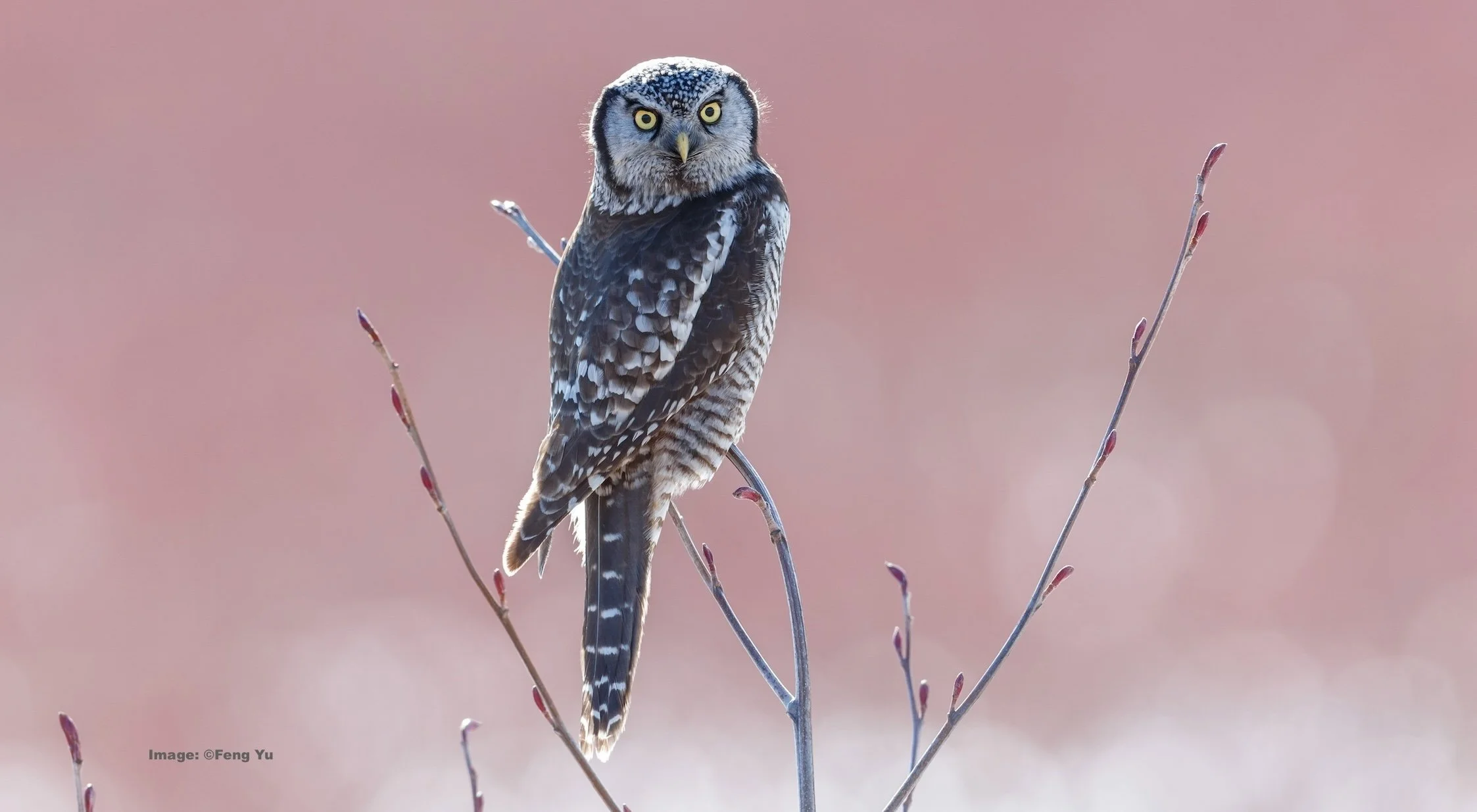
Northern Hawk Owl Fast Facts
Surnia ulula
Conservation Status: Least Concern.
✓ Length: 14.2 - 17.7 in (36-45 cm)
✓ Weight: 8.5-16.0 oz (240-454g)
✓ Wingspan: 27.9in (71cm)
✓ Daytime hunter
Why Northern Hawk Owls are Special:
With its unusually long tail for an owl, its short and pointed wings, and hunting behavior that is more hawk-like than an owl, the Northern Hawk Owl is truly unique. It is a non-migratory species with most of its range further north, but they do stray south, and northern Minnesota is where to see them. This is possibly the only diurnal owl you'll encounter. They actively hunt during daylight hours, and don’t seem to be as skittish around humans as most owls — making them a dream for photographers and birders alike.
What Brings Them to Minnesota:
These rare visitors from the far north seek small mammals like mice, voles, and squirrels, plus small birds, during the winter months when mammal populations become more scarce or difficult to find under thick snow in their breeding range up north.
Pro Tip: Northern Hawk Owls are perch hunters with excellent vision. Look for them atop dead trees (snags), power lines, and prominent perches with clear views over open areas. Northern Minnesota may be the only place in the continental United States to see this species!
Best Time to See Them:
January and February, particularly at dawn and dusk
Prime Viewing Locations:
• North Shore of Lake Superior
• Sax-Zim Bog and surrounding boreal forests
• Superior National Forest
• Lake, Cook, and St. Louis Counties
4. Great Horned Owl – The Tiger of the Sky
The Great Horned owl’s “horns” are actually feathers but it makes this big avian predator look even more formidable as it looks over its territory in an early dusk snowfall. Image: ©Chris Hill
Great Horned Owl Fast Facts
Bubo virginianus
✓ Conservation Status: Least Concern
✓ Length: 24-33in (61-84 cm)
✓ Weight: 24.7-60 oz (700-1700 g)
✓ Wingspan: 54-60.2in (137-153 cm)
✓ Eye Color: Gold
✓ Hunt: Night, dawn, and dusk
Why They're Special:
Great Horned Owls are powerful, adaptable predators found year-round in Minnesota. With distinctive ear tufts, fierce yellow eyes, and a haunting hoot, they're one of North America's most formidable raptors and earned their reputation as The Tiger of the Sky for their ability to take prey as large as opossums and Canada geese.
What The Great Gray Owl Hunts:
Without natural predators, the Great Horned Owl is free to hunt just about anything that moves in its realm. Consequently, these opportunistic hunters eat a diverse diet, including rodents, rabbits, ducks, grouse, and occasionally insects and reptiles. Fun Fact: Great Horned Owls have almost no sense of smell, which is perhaps the reason they are one of the few species to regularly prey on skunks!
Pro Tip: Great Horned Owls begin nesting in January or February—the earliest nesting bird in Minnesota. Listen for their classic "hoo-hoo-hoo, hoo-hoo" territorial calls on cold winter nights.
Best Time to See Them:
Great Horned Owls are year-round Minnesota residents, but winter offers the best visibility against snow-covered landscapes.
Prime Viewing Locations:
• Throughout Minnesota's forests, parks, and even suburban areas
• Particularly visible in Sax-Zim Bog
• State parks across Northeast Minnesota
5. Boreal Owl – The Elusive Forest Dweller
Being at the right place and time for this hunter’s attempt offered a rare ground sighting of the elusive Boreal owl in the Sax-Zin Bog. Image: ©Kim Risen
Boreal Owl Fast Facts
Aegolius funereus
✓ Conservation Status: (LC) Least Concern
✓ Length: 8.3-11.0 in (21-28 cm)
✓ Weight: 3.3 - 7.6 oz (93-215 g)
✓ Wingspan: 21.6-24.4in (55-62 cm)
✓ Roost Preference: Close to tree trunk
✓ Hunt: Night hunters
Why Boreal Owls are Special:
Boreal Owls are small, cute, and native to the thick boreal and subalpine forests across the world’s far north, from Alaska and across Canada to Eurasia, from Scandinavia and northern Siberia, where they are called "Tengmalm's Owl."
Boreal Owls are secretive, but they need to be. Great Gray Owls, Cooper’s Hawks, and other raptors, as well as the American or Pine Martin, a member of the weasel family, prey on the little owls and their chicks and compete for the same small mammal diet. This pressure, combined with their solitary habits, makes any sighting of the Boreal Owl a trophy for serious bird listers or lovers.

With their square-shaped head, bright yellow eyes, and perpetually surprised expression, Boreal Owls are delightful. Note: Female Boreal Owls are noticeably larger than the males,
Fun Fact 1: The Boreal Owl’s ears are asymmetrical, with one on top of its head and one lower, helping to locate not only where a sound is coming from but also how high or low it is originating.
Fun Fact 2: A study found that in Finland, the Boreal Owl’s tail is longer than that of their western cousins!
What They Hunt:
Small rodents, particularly voles and deer mice, plus occasional small birds and insects.
Pro Tip: The small Boreal owl may be the most challenging owl on our list to spot! They are expert at blending into their surroundings, strictly nocturnal, and prefer deep, mature coniferous forests, and roost next to the tree trunk. The best chance to find a Boreal owl is by joining a birding tour with an expert guide who knows the active territories.
Best Time to See Boreal Owls:
Late winter (February-March), when courtship time begins, listen for the males calling.
Prime Viewing Locations:
• Dense boreal forests in Minnesota’s Lake and Cook Counties.
• Superior National Forest
• Sax-Zim Bog region (rare but possible)
6. Northern Saw-whet Owl – The Tiny Treasure
Northern Saw-Whet Owl Fast Facts
✓ Aegolius acadicus
✓ IUNC: Least Concern
✓ Length: 7.1-8.3in (18-21 cm)
✓ Weight: 2.3-5.3oz (65-151g)
✓ Wingspan: 16.5-18.9 in (42-48cm)
✓ Eyes Color: Gold
✓ Hunt: Nocturnal!
Why Northern Saw-whet Owls are Special:
At just 7-8 inches tall, the size of a Robin, Northern Saw-whet Owls are among North America's smallest owls. Don't let their adorable appearance fool you—these fierce little hunters are perfectly adapted for northern winters. Despite being fairly common, their small size and excellent camouflage make them challenging to spot roosting during the day.
What They Hunt:
Primarily deer mice, voles, and shrews, with occasional small birds and large insects. Fun Fact: While many North American owls require multiple mice a day, the tiny Saw-whet Owl might have leftovers from a single mouse and cache it for a later meal.
Fun Fact: Saw-whet Owls get their name from one of their calls, which sounds like a saw being sharpened on a whetstone.
Best Time to See Northern Saw-whet Owls:
Late fall through early spring, particularly during migration (October-November)
Prime Viewing Locations:
• Dense conifer stands throughout Northeast Minnesota
• Sax-Zim Bog
• Superior National Forest
• During migration, even urban parks with suitable habitat
Beyond Owls: Other Winter Bird Highlights


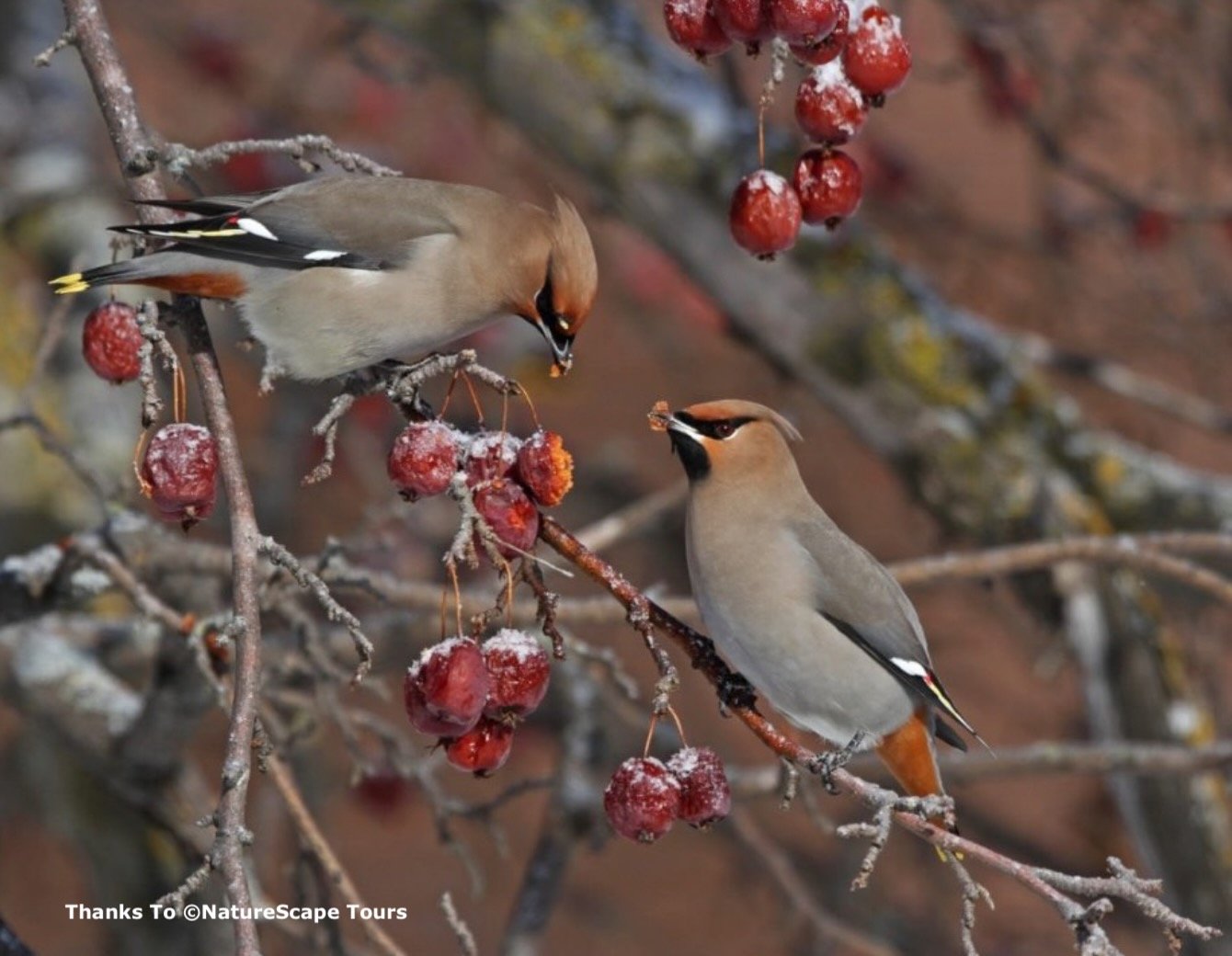

Minnesota's winter wonderland isn't just about owls. Keep your eyes open for these other spectacular northern species:
Spruce Grouse – The "fool hen" of the boreal forest, so tame it can sometimes be approached closely – but don’t. Stand back to enjoy this chicken-sized ground forager, and look for the male’s bright red eyebrow.
Black-backed and American Three-toed Woodpeckers – Rare boreal specialists that depend on burned forests
Red and White-winged Crossbills – Nomadic finches with crossed bills perfectly adapted for extracting conifer seeds.
Bohemian Waxwings – Elegant fruit-eating flocks that can number in the hundreds.
Minnesota’s Crown Jewel of Owl Watching: Sax-Zim Bog
. If you can only visit one location for winter birding in Minnesota, we recommend the Sax-Zim Bog.Image: ©Rebecca Warren
Why Sax-Zim is Special:
This 300-square-mile (482.8 sq. km) mosaic of boreal forest, black spruce bog, tamarack swamp, and open wetlands in St. Louis County has earned international recognition as one of North America's premier winter birding destinations – and it is beautiful in the snowy winter. Sax-Zim Bog owls are legendary among birders, with the area consistently producing exceptional sightings.
• The Birds! The 2024 Christmas Bird Count Sax-Zim logged over 63 species and over 8000 individuals wintering in forests and open landscapes. E-Bird reports reliable sightings of Great Gray Owls (often multiple individuals), regular Snowy Owl appearances in adjacent agricultural areas, good chance of Northern Hawk Owls during irruption years, and elusive Boreal Owls, as well as specialties like Black-backed Woodpeckers, Boreal Chickadees, “Hoary” Redpolls, and more.
• Winter owls! Sax-Zim Bog owls represent some of the most reliable winter owl viewing in North America.
• Wildlife! Birds are not the only residents of the Sax-Zim Bog. Keep an eye out for Moose, Pine Martine, and Snowshoe hare. You might even be lucky enough to see a bobcat or ermine! Oh, and a donated trail cam has caught timber wolves playing with a stick. Don’t worry, any wolves will steer far clear of you!
An accessible network of quiet rural roads is perfect for wildlife viewing, like this Snowshoe Hare, a favorite prey of wintering owls. Image ©Jim Commings
• Hey, it’s all about the Habitat! The Sax-Zim Bog encompasses 300 sq. miles( 779 sq km), of vital black spruce and tamarack bog, and also upland aspen/maple forests, floodplain forest, sandy upland pine stands, rivers, lakes, farms, meadows, and towns. This mix of habitats is what creates its unmatched variety of wintering birds - and the Mission of the Friends of the Sax-Zim Bog is to Preserve & Protect the Greater Sax-Zim Bog. “We do this so future generations of birds and birders will be able to enjoy this special place. We are creating a Forever Home for Great Gray Owls, Connecticut Warblers, and all boreal flora and fauna.”
The Best Months in the Sax Zim Bog for Owl Watching
Peak season for all winter owl watching in the Sax-Zim Bog is January-February, although early birds, like Snowy Owls, can arrive from Early November to December. Late February-March is best for Great Gray Owls, and they are more vocal as breeding season approaches and easier to find.
Local Resources:
The Friends have a great Sax-Zim Bog Birding Map that provides detailed routes, and the local birding community actively shares sightings on eBird and regional birding groups.
Understanding Owl Irruptions: Why Some Winters are Better Than Others for Owl Watching
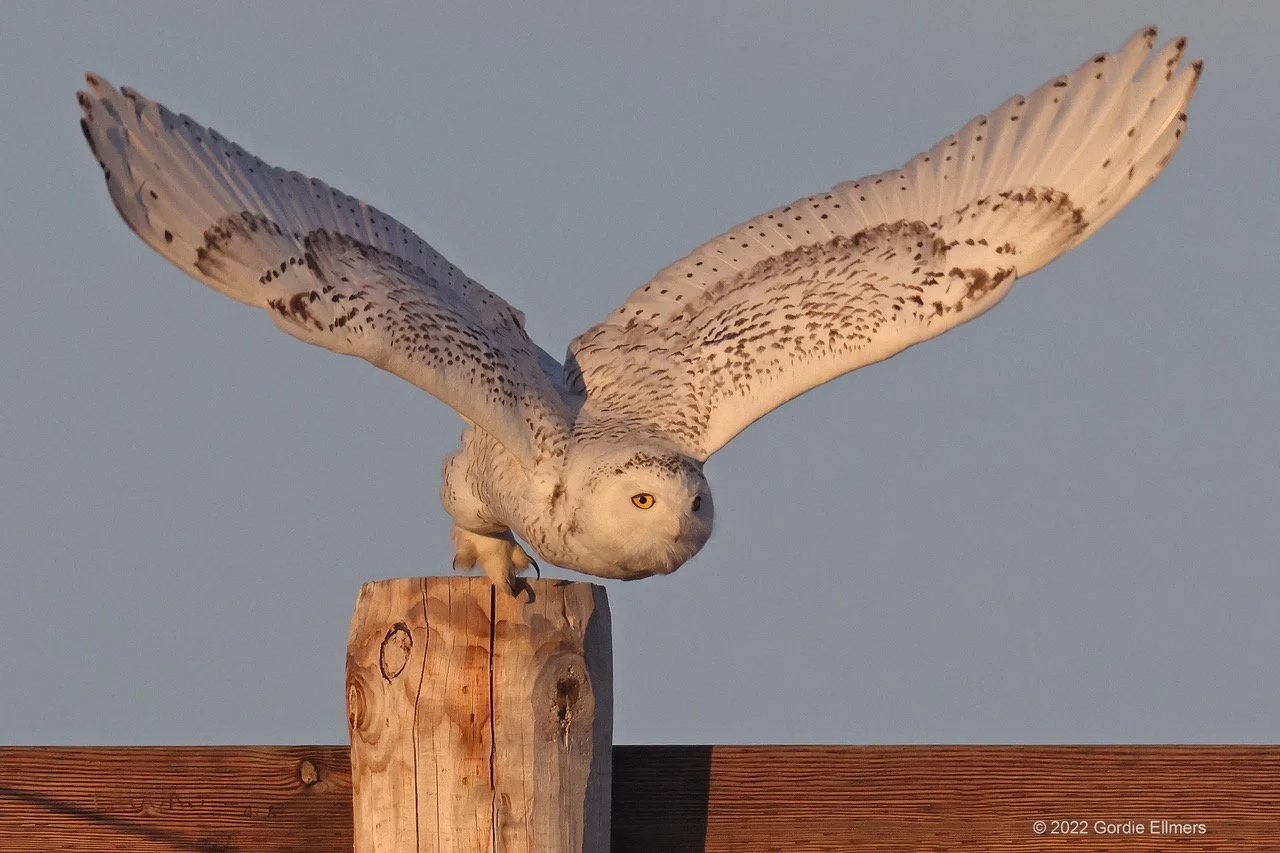
Why do owl numbers vary dramatically from year to year? The answer lies in irruptions—irregular migration events triggered by prey availability in the Arctic that make winter birding in Minnesota and elsewhere especially exciting during peak years. Image: ©Gordon Ellmers
Owl Irruption Myth Buster:
For many years, we thought that owl irruptions were triggered by a lack of prey – but we were wrong! Owl irruptions are triggered by an abundance of prey which leads to a greater than usual crop of new owls surviving to adulthood. These owls fly south in their first winter, following easier hunting as the cold and snow make prey more difficult to find. The record-breaking 2025 irruption brought extraordinary numbers of Great Gray Owls, Snowy Owls, and Northern Hawk Owls to Minnesota.
While we can't predict irruptions with certainty, experienced guides monitor Arctic breeding reports and early-season sightings to gauge each winter's potential. Current reports suggest promising conditions for the upcoming season!
Essential Tips for Ethical Owl Watching
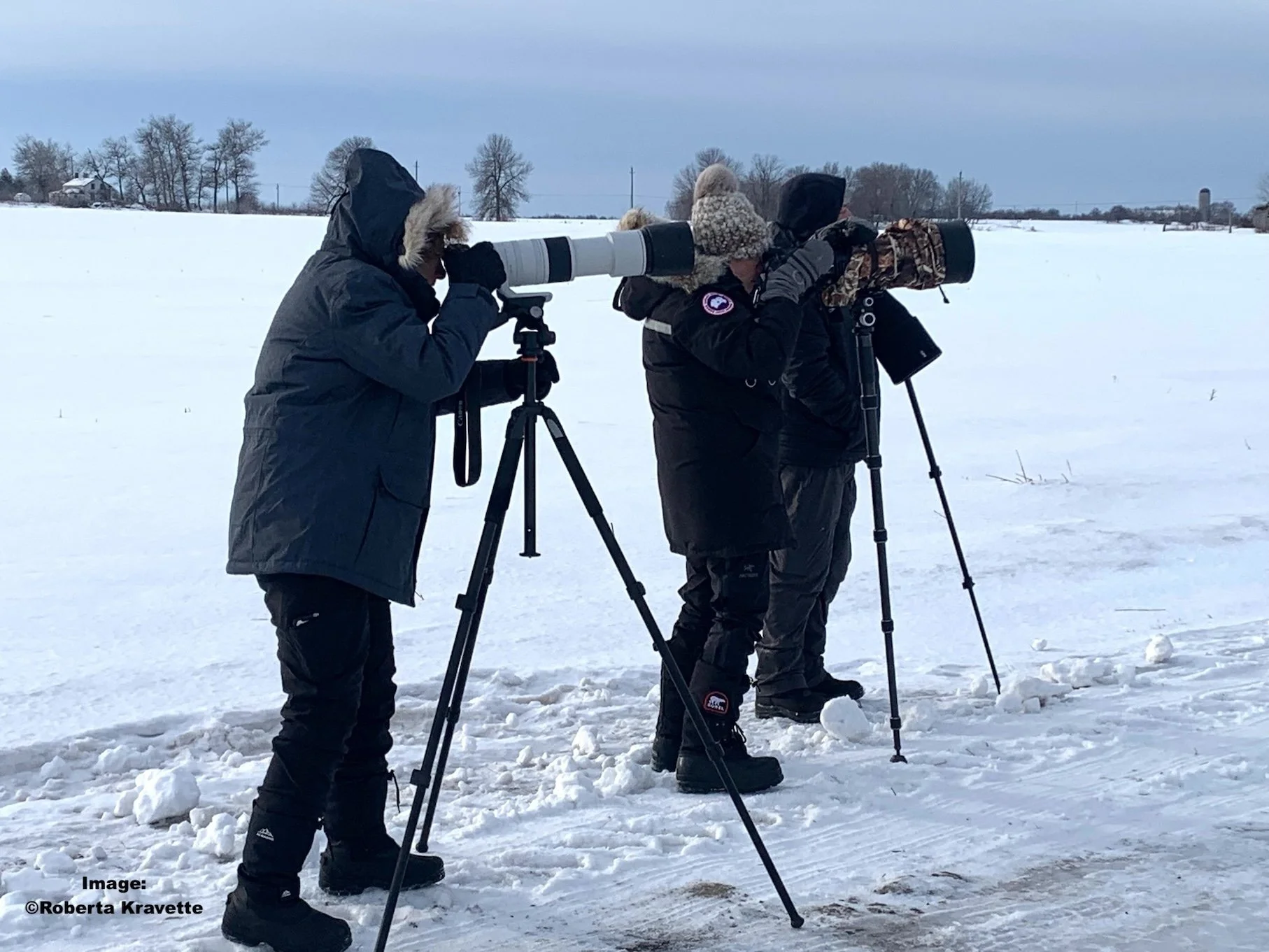
Spotting or photographing snowy owls from a distance is imperative to keeping the birds stress free and healthy. This is part of our group on 2025’s Project SNOWstorm fundraising tour. Image: ©Roberta Kravette
Responsible owl watching in Minnesota protects these magnificent birds while ensuring future generations can enjoy them. Following the guidelines below for owl and all bird watching ensures both your safety and the bird’s well-being.
Best Practices for Responsible Owl Watching: Do
✓ Maintain distance: Stay at least 300 feet away; use binoculars or telephoto lenses.
✓ Leave your dogs at home! They can’t help but get excited, and that spooks and stresses the birds
✓ Stay in your vehicle: Cars make excellent blinds and don't disturb wildlife as much as people on foot - and you’ll stay warmer! It’s cold out there!
✓ Limit time: If an owl is aware of your presence, keep visits brief (15-20 minutes max)
✓ Respect private property: Many prime areas are along private roads—follow local access rules. There are many documented instances of a landowner cutting owl” trees or changing their property’s landscape to discourage owls when human viewers do not respect their property and privacy. Don’t be the guy responsible for the destruction of the owls’ vital habitat.
✓ Drive safely: Watch for owls hunting along roadsides, especially at dawn and dusk
✓ Share responsibly: When posting sightings, be mindful of exact locations that could lead to crowding. General areas or good - specifics can be harmful.
And Some Don'ts for Responsible Owl Watching :
X Don’t use or strongly limit playback calls to attract owls or other birds —this wastes their energy and causes stress.
X Don't approach roosting or hunting owls on foot
X Never feed or bait owls—this alters natural behavior and can harm them. The use of bird feeders for seed, fruit, or suet eaters is a different story.
X Don't use drones—they terrify wildlife and are illegal in many areas
X Avoid flash photography except with explicit permission from guides in controlled situations
Remember: These owls are here to survive winter, not entertain us. They need to conserve energy for hunting and staying warm – undue stress causes excess energy use that they cannot easily replace. And in winter, added stress can result in death. If an owl flies away when you approach, you were too close.
Planning Your Minnesota Winter Owl Adventure: Important Tips for Owl Tours in Minnesota
Yes, it’s cold out there. The right clothes are imperative. Project SNOWstorm 2025 Scott Weidensaul, the CoFounder of Project SNOWstorm and our group, Penny, Dave, Diane, Nadir, Sherri, Amy and guide, Kim Risen. Image: Roberta Kravette
Successfully finding Minnesota winter owls requires preparation and knowledge. Whether you're planning your first owl watching Minnesota expedition or you're a seasoned birder, these essentials will help ensure a productive and comfortable experience.
What to Bring for Winter Birding :
✓ Optics: Binoculars (8x42 or 10x42) and a spotting scope if you have one.
✓ Camera: Long lens (400mm+). We will always stay a respectful distance from the birds and other wildlife. Don’t have a long lens? You may be able to rent one - or just relax and enjoy the moment.
✓ Warm clothing: Layered system including insulated boots, parka, warm gloves, and hat - see our
✓ Vehicle essentials: Winter survival kit, extra food and water, full charge or tank of gas
✓ Navigation: GPS device or smartphone with offline maps downloaded.
✓ Field guide: Cornell's All About Birds app or Sibley Guide to Birds are both very helpful.
Why Book a Guided Tour vs. Going Solo

Traveling with fellow bird lovers is a treat. This is our 2025 group for Project SNOWstorm, warming up after a successful day of owl watching. Next up - dinner! That’s me on the left, then Nadir, Scot Weidensaul, Sheri, Diane, Amy, Elizabeth, Marianne, and Penny. Image: Roberta Kravette
While independent exploration is can be fun and successful in smaller local parks, an experienced guide offers tremendous advantages to winter birding in Minnesota’s Sax-Zim Bog and surrounding areas:
The Expert Knowledge
An experienced local guide can be invaluable for: • The Right Location: You are not in Disneyland, the birds are not waiting for you! An experienced local guide has a better chance of knowing current hotspots of the most elusive owl and adjusting your route based on recent sightings. You save time and enjoy better spotting results. • Owl and Other Identification: A professional can usually identify a species from its silhouette, flight pattern, or call – helping you understand what you are seeing – even at a distance.• Camouflage Detection: Owls are expert at hiding in plain sight, but an experienced guide knows their tricks, spotting hidden owls you'd otherwise miss • Understanding of bird behavior. What’s that bird doing? The right guide can explain. Understanding Challenges to the Bird’s Survival: The right (responsible) guide can fill you in about owl ecology, migration patterns, and conservation challenges. Understanding leads to more satisfying sightings.
Efficiency!
When you’ve traveled to see the bird, and especially when it's freezing temperatures, there is no time to waste! • The guide’s knowledge allows you to see more species in a limited time. And waste less time navigating unfamiliar roads or uncertain locations.
And then there is Safety and Comfort.
• Heated vehicles and strategic planning keep you comfortable in sub-zero weather • Local knowledge of services, weather conditions, and backup plans • Safety in numbers when exploring remote areas. Never go into remote or unfamiliar areas alone. One small accident or wrong turn, or one unexpected weather event can be disastrous.
And sharing your exploration with a small group of like-minded travelers is fun!
Can Bird Watching Make the World a Better Place?
In some ways, yes! Responsible Viewing, whether it is for birds, wildlife, or marine life, supports local economies by frequenting local cafes and restaurants, using locally owned accommodations, local guides, and generally participating in the local economy! When nature supports the local economy, the local population is more willing to protect nature. That’s good news for today and for future generations.
So what is our role as viewers? When we follow best viewing practices, support local economies, and are respectful of both people and animals, we are participating in ethical and responsible wildlife viewing - and it’s fun.
Join Our Minnesota Winter Owl Expedition
Ready to Experience the Magic of Minnesota's Winter Owls - AND - Help to Support Snowy Owl Research?
This year, our annual fundraiser birding tour destination is Minnesota! Our expertly guided Winter Owl Adventure is designed specifically for finding Minnesota winter owls and combines years of local knowledge, optimal timing, and small group sizes (maximum 8 participants) for an unforgettable wildlife experience - and 10% of every ticket is a donation in YOUR name (good for your taxes) to Project SNOWstorm.
What's Included:
✅ 4 days / 3 nights of intensive owl watching
✅ Expert naturalist guide with decades of Minnesota birding, wildlife photgraphy and conservation experience
✅ Comfortable heated transportation throughout the tour
✅ All entrance fees to wildlife management areas
✅ All Meals and Accommodations
✅ Pre-trip preparation, including packing lists and species information.
✅ Small group size ensuring everyone gets quality viewing time
Our 2025 Winter Owl Itinerary Highlights: 6 days / 5 Nights, January
• Day 1: Evening arrival in Duluth, welcome dinner, and trip briefing
• Day 2: Morning exploration of Duluth’s birding hotspots (Bohemian waxwings!), afternoon in the Sax-Zim Bog
• Day 3-5: Superior, Northeastern Minnesota’s Aitkin, Cook, Lake, and St. Louis Counties. The birds themselves will dictate our route for these three exciting days, but it will include exploration of the Sax-Zim Bog, the Boundary Waters Canoe Area Wilderness, the Tamarack peatlands of Aitkin County, and Lake Superior’s north shore. On our 5th evening, we will celebrate our Minnesota Winter Owls with a final dinner together.
• Day 6: Morning birding session for anything we may have missed, or a last look at a favorite, then return to Duluth by early afternoon, catch your flight home, or let us know, and we will arrange accommodations for you to overnight. Review the full itinerary here
Investment: $4514.00 Double occupancy, ex-flights.
2025 Departure Dates: January 14 - 19
👉 Reserve Your Spot Now – Limited to 8 participants per departure
Frequently Asked Questions
Q: How cold will it be?
A: January temperatures typically range from 0°F to 20°F (-18°C to -7°C), with occasional dips below zero. Our heated vehicles and strategic planning keep you comfortable.
Q: What if we don't see certain owl species?
A: While we can't guarantee specific species (they're wild animals and have their own agendas!), our past winter birding tours in Minnesota have an excellent track record with good sightings of Great Gray, Boreal, Northern Hawk Owls, Snowy owls, and a plethora of winter songbirds, woodpeckers, grouse, wintering waterfowl, and more.
Q: Is this itinerary physically demanding?
A: No. Most viewing happens from heated vehicles, with only short walks on level terrain. We will encounter snow and ice. The tour is best for people with good mobility, a walking stick is recommended to help with balance on icy terrain. Yaktracs are recommended.
Q: Can you accommodate dietary restrictions?
A: Most dietary restrictions can be accommodated. Please inform us of any dietary needs when booking.
Q: What Makes This Tour with Destination: Wildlife Special?
A. Aside from expert guides, a fabulous itinerary, and all the details above, this tour helps protect the birds in two ways!
1) We support the local communities and their economy through our mandate to eat, sleep, learn, explore, and enjoy locally! While you are enjoying the experience, your experience is supporting local communities and economies, making it easier for them to protect nature - rather than developing it.
2) Conservation and Research: 10% of your trip cost is a tax-deductible donation in YOUR name to Project SNOWstorm, the world’s most important Snowy Owl research program.
Q. Who is this tour best suited for?
A. Adults over 18 years. Minnesota's winter owls offer a wildlife experience unlike anything else in North America. These Arctic visitors brave extreme conditions to winter here, creating once-in-a-lifetime viewing opportunities for those willing to bundle up and head north on owl tours in Minnesota.
Whether you're a dedicated birder chasing life list species, a wildlife photographer seeking that perfect shot, or simply someone who appreciates nature's magnificent creatures, Minnesota birding tours during winter owl season deliver unforgettable memories.
Don't wait—our small group sizes fill quickly, especially for prime January departures. Book Now and Save Your Spot
Connect With us
Know someone who would love this experience? Use the share buttons below to spread the word! For every friend who books using your referral code, you'll receive $100 off your next wildlife adventure.
Share on Facebook | Share on Instagram | Email to a Friend
Three Easy Ways to Book
📞 Call or text: Roberta Kravette +1 908-656-4016
📧 Email: Rkrvette@signpostpublishing.com
🌐 Online: Review the Itinerary and details or
Ask me a Question or Book Your Spot
Additional Resources. Learn More About Minnesota's Owls:
• Cornell Lab of Ornithology: All About Birds – The most reliable resource for bird information
• Project SNOWstorm – Tracking and conservation research on Snowy Owls
• Sax-Zim Bog – Local birding maps and recent sightings
Ready to experience this once-in-a-lifetime wildlife spectacle? Join our expert-guided Minnesota Winter Owl Adventure and witness these Arctic visitors up close. Your winter owl watching adventure in Minnesota awaits!

Roberta Kravette is the Co-founder of Destination: Wildlife. She is an avid conservationist, devoted to helping the many conservation-missioned nonprofit organizations in the United States and around the world fulfill their mandates. She believes that no matter how young or old, able or challenged, wealthy or not, we are, each of us has a right to enjoy nature, and each of us has an important role to play in protecting it.